





In brief
- Trump’s aggressive pro-crypto push reshaped U.S. policy while also raising conflict-of-interest and civil liberties concerns.
- Privacy advocates say DOJ prosecutions have undercut Bitcoin’s core value of censorship resistance.
- Crypto’s new influence in D.C. has boosted aligned firms, but left others feeling vulnerable heading into 2026.
A year ago, America’s top crypto executives had never stepped foot inside the White House. They had never mingled with the Treasury Secretary, or hosted top DOJ officials at swanky offsite summits—or passed a major federal law. They also had never seen the digital assets they helped create climb so high in value, or so quickly.
These victories have many authors. But they all would have likely been impossible without the support of the president of the United States.
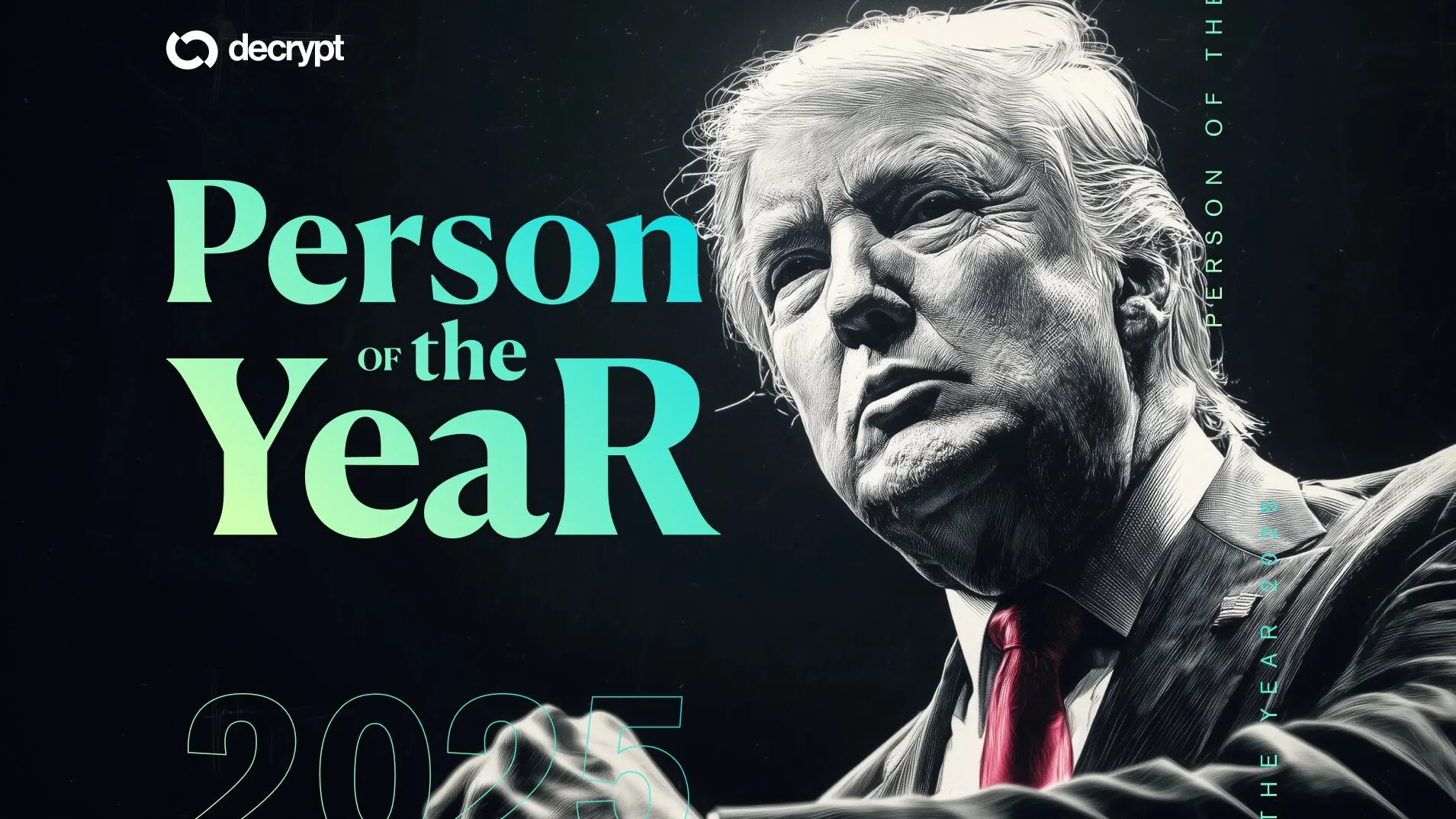
In the last twelve months, President Donald Trump has arguably had more impact on crypto than anyone since the industry’s founding fathers. At his direction, the federal government has torn down the barriers insulating digital assets from the traditional economy. His regulators shuttered investigations and lawsuits that once plagued nearly every major crypto firm in the country. And his White House led a successful effort to permanently enshrine the industry’s legitimacy in federal law.
Amid the push for these reforms, the president and his family have also made billions of dollars off crypto projects—an act that is also without precedent in American history. Digital assets are not merely a policy priority of the Trump administration; they are now the cornerstone of the Trump family fortune.
Many crypto proponents see these developments as a net positive, both for their bank accounts and for the industry’s long-term health. But others—particularly Bitcoin’s early, ideologically minded adopters—think the president’s embrace of crypto has been, at best, irrelevant to their mission. At worst, they say, Trump’s new position at the center of the crypto universe has severely eroded Bitcoin’s ability to serve its original purpose: as a guarantor of civil liberties and a bulwark against authoritarianism.
Actions and Words
For over a decade, the Human Rights Foundation, commonly known as the HRF, has used Bitcoin as a means to covertly fund the activities of human rights and democracy advocates living under autocratic regimes in Russia, Nigeria, Nicaragua, and China. The organization’s chief strategy officer, Alex Gladstein, considers Bitcoin not just a useful tool for circumventing borders, but an embodiment of the global fight for liberty.
If you want to make a token, and as long as you let the Trump family invest in it, then I guess sure, you'll be fine.
“Bitcoin is freedom,” Gladstein told Decrypt. “It is an open network that anybody can use, that can't be stopped, that cannot be controlled by any government or corporation. It is the instantiation of civil liberties.”
In Gladstein’s view, a year of White House announcements cheered endlessly by crypto companies and venture firms—a federal Bitcoin reserve, an end to SEC oversight of crypto, digital assets in 401(k)s—has nothing to do with the core mission of Bitcoin or other blockchain networks.
“They're trying to create a regulatory climate where you can scam whoever you want and nothing happens,” Gladstein said of the Trump administration. “None of that is really relevant to what we're working on, or to Bitcoin.”
“If you want to make a token, and as long as you let the Trump family invest in it, then I guess sure, you'll be fine,” he said, alluding to the first family’s numerous business entanglements with top crypto companies. “And I guess you wouldn't have been fine under Biden. But that's just not that interesting to me.”
The White House has repeatedly denied that the Trump family’s crypto dealings have impacted the president’s crypto agenda.
“The media's continued attempts to fabricate conflicts of interest are irresponsible and reinforce the public's distrust in what they read,” White House press secretary Karoline Leavitt said in a statement to Decrypt.
“Neither the President nor his family have ever engaged, or will ever engage, in conflicts of interest,” she added. “Through executive actions, supporting legislation like the GENIUS Act, and other common-sense policies, the administration is fulfilling the President’s promise to make the United States the crypto capital of the world by driving innovation and economic opportunity for all Americans.”
Old-school Bitcoiners like Gladstein argue it would be one thing if Trump merely pursued a pro-crypto agenda out of self-interest. But the president’s administration has also taken steps this year to undermine crypto’s ability to safeguard civil liberties, they say—a far more concerning development.
This summer, the Trump Department of Justice secured criminal convictions against developers of two different crypto privacy tools—one hosted on Bitcoin, and another on Bitcoin’s chief competitor, Ethereum. These services allowed users to keep their crypto transactions private without ever transferring funds to a human third party.
Given blockchain networks like Bitcoin and Ethereum publicly display every user’s transaction history, tools that obfuscate these transactions have become massively popular with users who want to keep the details of their crypto transfers to themselves. The Trump DOJ argued in court that the services thrived off criminal activity and constituted unlicensed and illegal money transmitting services.
The Bitcoin-focused privacy tool, Samourai Wallet, was co-founded by software developer Keonne Rodriguez in 2015. Rodriguez said he and a friend created Samourai because, even back then, Bitcoin was drifting away from its origins as a tool for resisting government censorship—and towards pure profit-seeking.
“It was kind of disappointing and shocking, because we got into Bitcoin for very different reasons than just another thing to make money off of,” Rodriguez told Decrypt. “I wanted to build a circular economy outside of the realm of the state.”
“I think that was pretty common back then,” Rodriguez said. “Obviously, that's not where we are today.”
The criminal charges against Rodriguez and his co-founder, William Longeran Hill, were filed by the crypto-skeptical Biden administration last spring. But this year—even as the Trump DOJ invited controversy by dismissing a slew of ongoing criminal cases it inherited from prior administrations—the charges against Rodriguez, Hill, and Tornado Cash developer Roman Storm remained.
“The fact that we were indicted under the Biden administration's Department of Justice, that kind of made sense,” Rodriguez said. “I don't think it was right, obviously, but at least it made sense.”
In April, Trump’s deputy attorney general, Todd Blanche, directed federal prosecutors to stop pursuing cases against intermediary crypto privacy tools. A few months later, a senior DOJ official promised a room full of crypto policy leaders that the department would back off prosecuting decentralized software developers. And yet, at the same time, the Trump DOJ pursued the maximum possible prison sentences for Rodriguez and his fellow coders.
The federal government looks at Bitcoin as a fully captured network they can see into very easily, more so than with cash.
Last month, the Trump administration got its wish. Facing 25-year sentences if they went to trial, Rodriguez and his 67-year-old colleague opted to instead plead guilty to one count of operating an unlicensed money transmitter. Rodriguez was sentenced to five years in federal prison, the maximum possible punishment. His partner got four years.
Privacy advocates argue the case has already had a demonstrable chilling effect on the development of blockchain privacy tools in the United States. Rodriguez believes this was the purpose of the case against him—to neutralize Bitcoin’s ability to serve as a financial rail outside the government’s control.
And that was the whole point of Bitcoin from the beginning. That was the seed that sprouted—or mutated, depending on one’s view—into the current $3.3 trillion crypto industry. Without privacy functionality, Bitcoin isn’t just useless, Rodriguez believes. It’s dangerous.
“I think the federal government looks at Bitcoin as a fully captured network they can see into very easily, more so than with cash,” Rodriguez said. “A true peer-to-peer electronic cash should scare the federal government. But an electronic investment? That's not scary at all.”
Trump and his cabinet have repeatedly pledged to ban the development of a central bank digital currency, or CBDC—a government-issued token critics have dubbed “Big Brother’s digital dollar.”
“I don't think the federal government needs to do it,” Rodriguez said of the creation of an American CBDC. “They have one. They have Bitcoin.”
A Trumpian Bargain
Some privacy advocates worry not only about the state of the fight for digital privacy in the Trump era. They have also grown increasingly distressed about how closely Bitcoin—a technology they see as foundational to a global fight for freedom—is becoming associated with a president and an administration they believe are displaying authoritarian tendencies.
The Trump administration has faced harsh legal and political rebukes this year over actions critics say have violated Americans’ civil liberties—ranging from attempts to deport protestors for political speech, to its treatment of ICE detainees, to its threats regarding the broadcasting freedom of national television and radio networks.
“Bitcoin aligns itself beautifully with liberalism, and liberalism is all about individual liberty, and civil rights, and freedom of expression,” Pourteaux, a pseudonymous decentralization advocate and longtime Bitcoin user, told Decrypt. “But now it’s associated with authoritarian-style politics, just because this bargain was made.”
Pourteaux says he understands why crypto leaders and President Trump appear to have entered into an unspoken deal. The industry is getting all sorts of regulatory favors, he said, and the president and his family are making billions of dollars from crypto-related ventures. But Pourteaux worries this cozy relationship will have lasting effects, long after the president leaves office.
“I'm definitely not against the government adopting or getting involved with Bitcoin,” he said. “I just am more concerned with the damage that we're doing to Bitcoin's reputation among the public.”
Some crypto policy leaders will admit—in private, at least—that the president’s agenda is largely at odds with crypto’s ideological mission. But they maintain that if they can score victories for decentralized technology in collaborating with Trump, then their present discomfort will have been worth it.
“I just want to pass legislation that protects people's civil liberties,” one crypto policy leader, who requested anonymity to speak candidly, told Decrypt. “And even if it's from a president who's not always the greatest defender of civil liberties, if he's willing to sign this piece of legislation, I'm going to work with that administration.”
This year, the crypto industry’s most significant political (and only legislative) victory was the passage of the GENIUS Act, which created a legal framework for issuing and trading stablecoins in the United States. Stablecoins are cryptocurrencies typically pegged to the value of the U.S. dollar, and backed by U.S. Treasuries held in reserve.
The Trump administration mainly advocated for the bill by arguing it would increase demand for U.S. Treasuries and bolster the global supremacy of the U.S. dollar.
“It has nothing to do with Bitcoin,” Alex Gladstein said. “The GENIUS Act has to do with cementing stablecoins as a pillar of U.S. economic policy and expanding the fiat system. I mean, this is just like a new arm of the octopus.”
When it comes to legislation, privacy advocates are chiefly concerned with the passage of a crypto market structure bill. Among many other items, a version of the bill that passed the House this summer contained provisions that would prevent the DOJ from going after privacy tools like Samourai Wallet and Tornado Cash as unlicensed money transmitters.
But the bill is currently languishing in the Senate, and despite public signals of optimism, there is a growing consensus among industry policy leaders that the sprawling bill now stands near-zero chances of passage. Too many obstacles stand in its way, and the upcoming midterm elections will grind Congress to a halt by spring.
What’s more, Democrats are poised to take back the House next November. And crypto policy leaders are preparing for the possibility that, should House Democrats use their new majority to impeach Trump, the focus of that inquiry will be the president’s perceived crypto-related conflicts of interest. Such a crypto-centered showdown would make an unlikely backdrop for the passage of a bill legitimizing those very same ventures.
“If the left comes into power again, I don't think there's going to be much sympathy towards crypto and Bitcoin, and these wealthy people,” Pourteaux said. “There's just an enormous amount of grifting and corruption happening in plain sight.”
“What Do I Get?”
A year ago, most crypto firms didn’t have a full-time presence in Washington. Now, the capital is teeming with these companies’ government affairs specialists and lobbyists, who have become staples at the city’s hottest members-only clubs. When a Bitcoin-themed bar opened near the White House last month, Treasury Secretary Scott Bessent dropped in on the festivities.
One of the most well-connected organizations in D.C.’s new crypto power structure is the Bitcoin Policy Institute, or BPI. Last year, the organization had only three full-time employees and no physical office. Now, it boasts a team of nearly 20, and some of the tightest relationships in town with both Capitol Hill and the White House.
BPI was a key player in the push to create a federal strategic Bitcoin reserve, which President Trump established via an executive order in March. A strategic Bitcoin reserve would involve the United States stockpiling large quantities of the digital asset—as it already does with assets like gold—to hedge against the depreciation of the dollar.
I don't know if people are coming to crypto now for the cypherpunk and libertarian values.
BPI’s co-founder, Grant McCarty, says such accomplishments have been crucial to the organization’s end goal of expanding Bitcoin’s adoption and popularity.
“The game of money is a game of legitimacy,” McCarty told Decrypt. “And this last year has been one of just incredible signal that the global superpower is embracing Bitcoin.”
Others, who have spent far longer in Washington advocating for crypto-related causes, feel less enthused about the city’s new dynamics. Coin Center, founded in 2014, is the capital’s oldest running crypto policy think tank. Its small team–which focuses on digital assets and civil liberties—has noticed big shifts in the priorities of newer industry entrants.
“I don't know if people are coming to crypto now for the cypherpunk and libertarian values,” Neeraj Agrawal, Coin Center’s communications director, told Decrypt. “I definitely feel a lot more that I don't have anything in common with these people.”
But the organization's executive director, Peter Van Valkenburgh, maintains that regardless of where America and the crypto industry are headed next—even if it’s an ugly place—Coin Center’s work is as meaningful as ever.
“The most important thing in the long sweep of civil liberties and the arc of history is to allow these technologies to grow to the point where they're unstoppable,” Van Valkenburgh said. “And then God forbid we have a totalitarian regime in the U.S., it's going to be very hard to have that in a world where people have become acculturated and familiar with the usage of peer-to-peer, liberty enhancing technology.”
If that outlook requires some amount of faith, it’s a faith that Keonne Rodriguez, the convicted Samourai Wallet developer, doesn’t share. It’s been hard for Rodriguez to feel hopeful these days about anything—either his personal situation, or what he sees as the steady erosion of privacy rights, and any concern about them, in the United States.
Because he pleaded guilty to the government’s charges, Rodriguez forfeited his right to appeal his case. His only shot at avoiding half a decade in prison is now a presidential pardon.
In the last few months, President Trump has made eager use of his pardon powers. And those actions have certainly benefited crypto founders. In October, for instance, Trump pardoned one of the industry’s most prominent figures, Binance founder Changpeng Zhao—paving the way for Zhao, known as CZ, to return to his crypto exchange after pleading guilty to violating anti-money laundering laws in 2023.
Rodriguez is currently gathering signatures on a petition asking Trump to pardon him and his Samourai co-founder. But he’s not too hopeful about that, either. There’s clearly a certain type of crypto founder Trump has been inclined to pardon in recent months, Rodriguez says, and he doesn’t fit that bill.
“It's a transactional thing, right?” Rodriguez said. “‘I get you a pardon, and what do I get?’”
Zhao’s company, for instance, played a crucial role in the growth and success of the Trump family’s crypto company, World Liberty Financial. Earlier this year, MGX—an Emirati state-owned firm—used World Liberty’s relatively untested stablecoin to back a $2 billion investment in Binance. That single deal led to the issuance of the majority of the Trump token’s global supply, and vaulted it to prominence.
Binance also supplied World Liberty with a team of coders to build out the stablecoin in the first place, according to the Wall Street Journal.
“We're not CZ,” Rodriguez said. “We don't have billions of dollars. We don't have the same type of influence people like that have.”
A White House official declined to comment on the likelihood that Trump will pardon Rodriguez and his colleague.
“President Trump is the final decider on all clemency requests,” the official said.
Rodriguez created Samourai Wallet a decade ago because he worried that principles were losing out to money in the war for Bitcoin’s soul.
Now it’s hard for him to escape the conclusion that the battle has been lost. It’s right there, in the question he keeps asking himself as he prepares to leave his family behind and report to a federal prison in West Virginia on Friday.
What does someone like him have that this president could possibly want?