






In brief
- A Federal Reserve study found US programming job growth dropped roughly 50% after ChatGPT launched in November 2022.
- Researchers estimate roughly 500,000 developer jobs that would have otherwise existed were never filled.
- The employment gap didn't appear until mid-2024—about 18 months after ChatGPT's launch.
The Federal Reserve just put a number on something developers have been experiencing for two years.
A new study by Fed economists Leland D. Crane and Paul E. Soto found that employment growth among U.S. programmers dropped roughly 50% after ChatGPT launched in November 2022. Before that, programming-intensive jobs were growing at around 5% annually—well above the overall labor market.
Since then, growth has fallen sharply. In the sectors most concentrated with programmers, like IT services and software development, it has essentially flatlined.
This is the first Federal Reserve-level study to directly link AI adoption to a measurable, occupation-specific decline in developer hiring, pointing to AI as the cause of an occupation-specific shock.
The tech sector took a beating in 2022 from interest rate hikes, the end of the pandemic digital boom, and the crypto crash. Skeptics have always argued that those factors alone explain the developer slowdown.
Crane and Soto addressed that directly. They built a counterfactual—how many programmers would exist if their share within each industry had stayed constant—and found programmer employment still falling by about 3% per year even after stripping out those effects. Non-AI-exposed occupations showed no comparable dip.
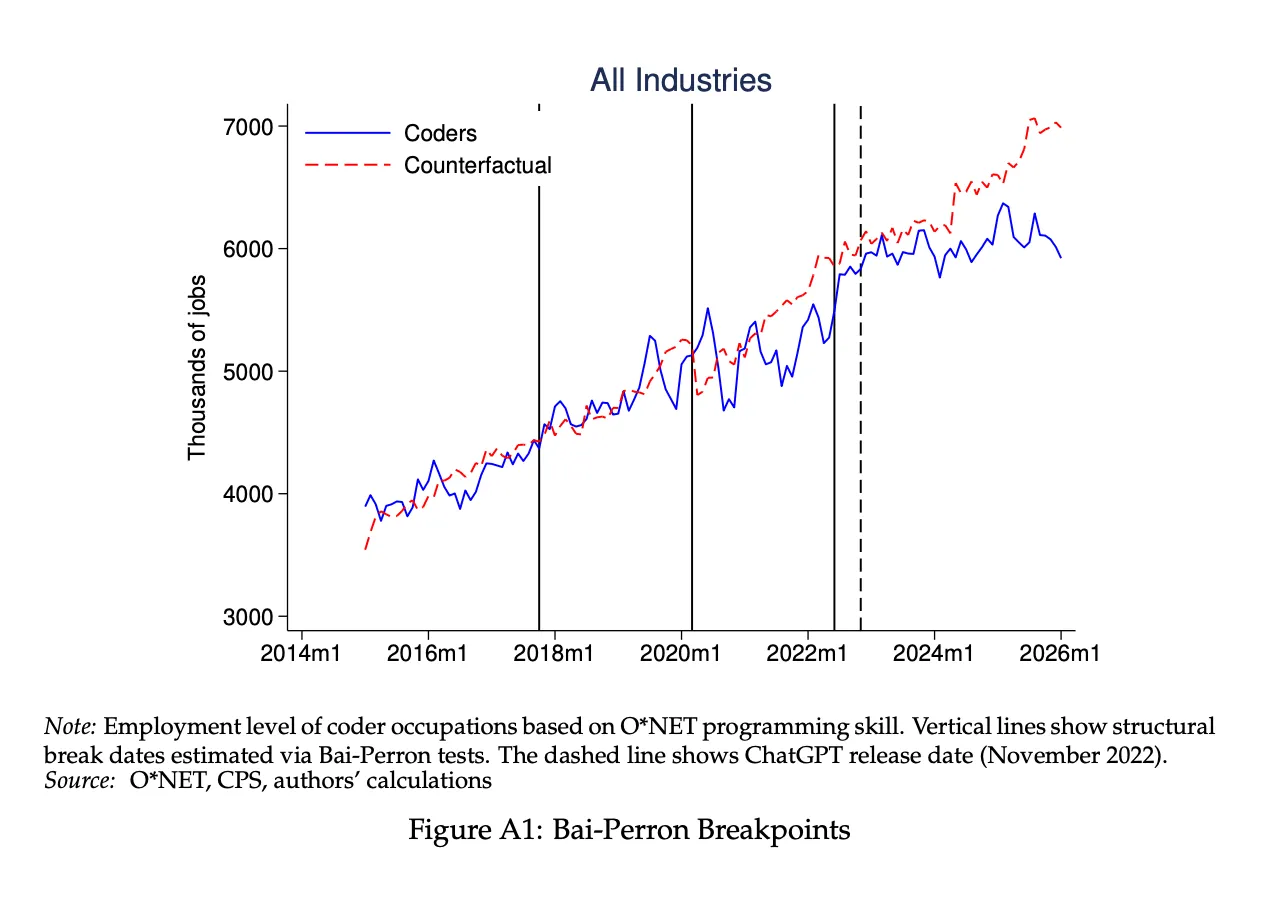
Stretched over three years, the gap amounts to roughly 500,000 jobs that would likely have existed without the rise of large language models. The authors strongly caution against reading this as a direct count of lost jobs. Many affected workers probably found work in adjacent fields, and the study doesn't capture broader macroeconomic feedback. But the signal is there.
The employment gap didn't open until mid-2024, roughly 18 months after ChatGPT launched. The researchers suggest companies needed time to see LLM capabilities improve enough to trust them before pulling back on headcount. Whether that reflects actual productivity gains or just the expectation of them, the data doesn't resolve.
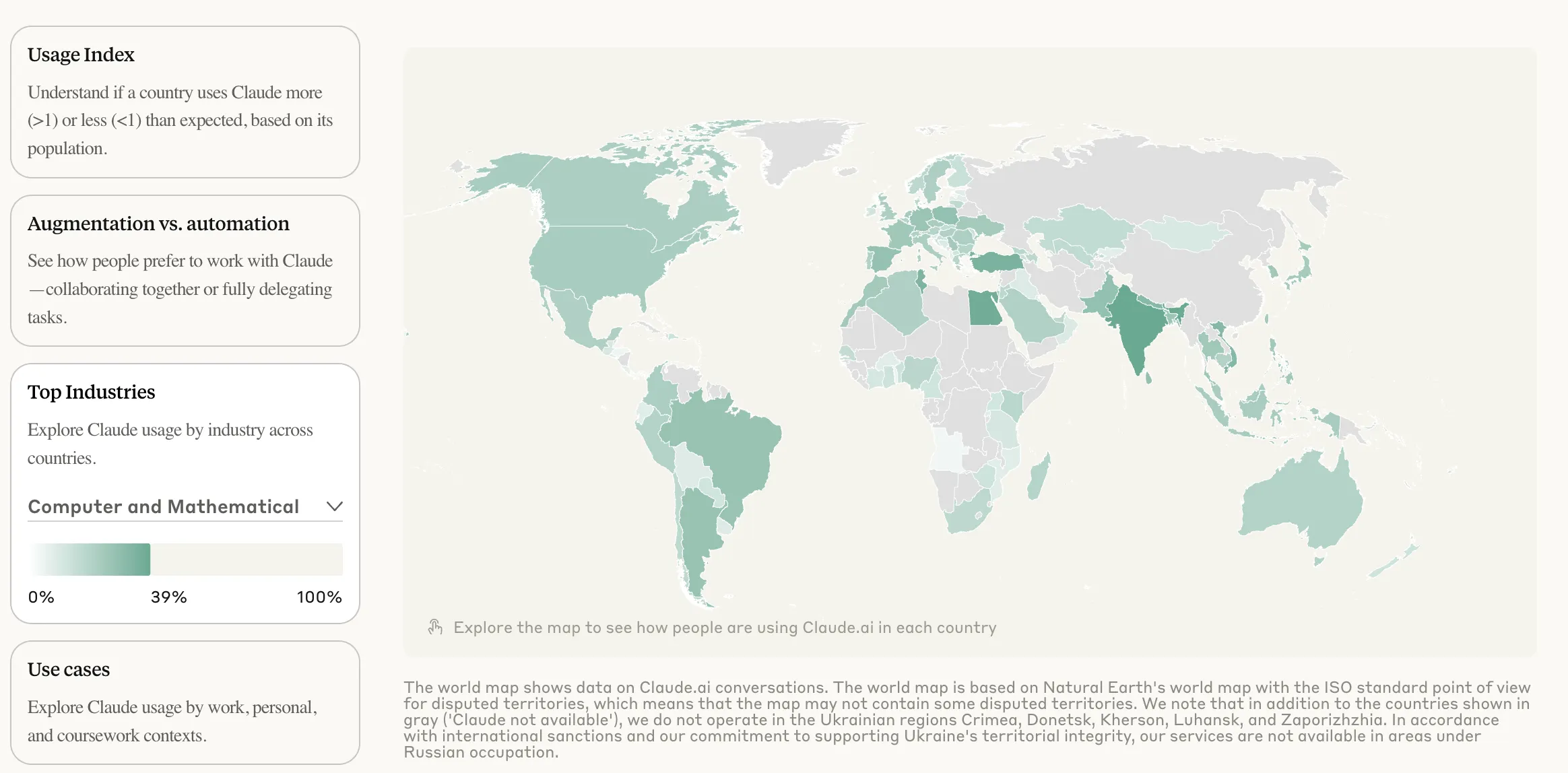
The study shows that programmers are the most AI-exposed occupational group in the country, which tracks with actual usage data. Anthropic's Economic Index shows that computer and mathematical tasks—coding, debugging, software architecture—account for roughly a third of all Claude.ai conversations and nearly half of enterprise API traffic.
The longer-term concern is the pipeline. A Decrypt report last year documented accelerating AI-driven layoffs across white-collar sectors, with Anthropic CEO Dario Amodei warning that up to 50% of entry-level roles could disappear within five years.
The Fed study adds institutional weight to what was previously anecdotal: a Harvard study of 62 million automatic data processing payroll workers found that junior developer employment drops roughly 9-10% within six quarters when companies adopt generative AI, while senior employment barely moves.
“If A.I. disproportionately affects junior positions, it could have lasting consequences for the college wage premium, upward mobility and income disparities,” Harvard researchers wrote.
Beyond the Fed, other analysts are raising concerns over tech jobs slowing due to AI automation and replacement. A recent multi-university survey of 69 economists, 52 AI experts, and 38 superforecasters found broad agreement that faster AI progress means lower labor force participation, including among researchers who previously held the "augment, not replace" consensus.
The Fed researchers don't frame the findings as catastrophic. Wages for programmers haven't declined—the effect has shown up in headcount, not pay. Job postings stabilized in 2024 and have ticked slightly upward since. The authors note that cheaper AI-assisted programming could open new markets and grow total demand for developer labor over the long run.
Crane and Soto describe their work as "only a first step." The study was published as a preliminary designation, meaning it hasn't completed the full Fed review process. But it's the first step produced inside the Federal Reserve, with the methodology and institutional weight that carries.