Add Decrypt as your preferred source to see more of our stories on Google.
In brief
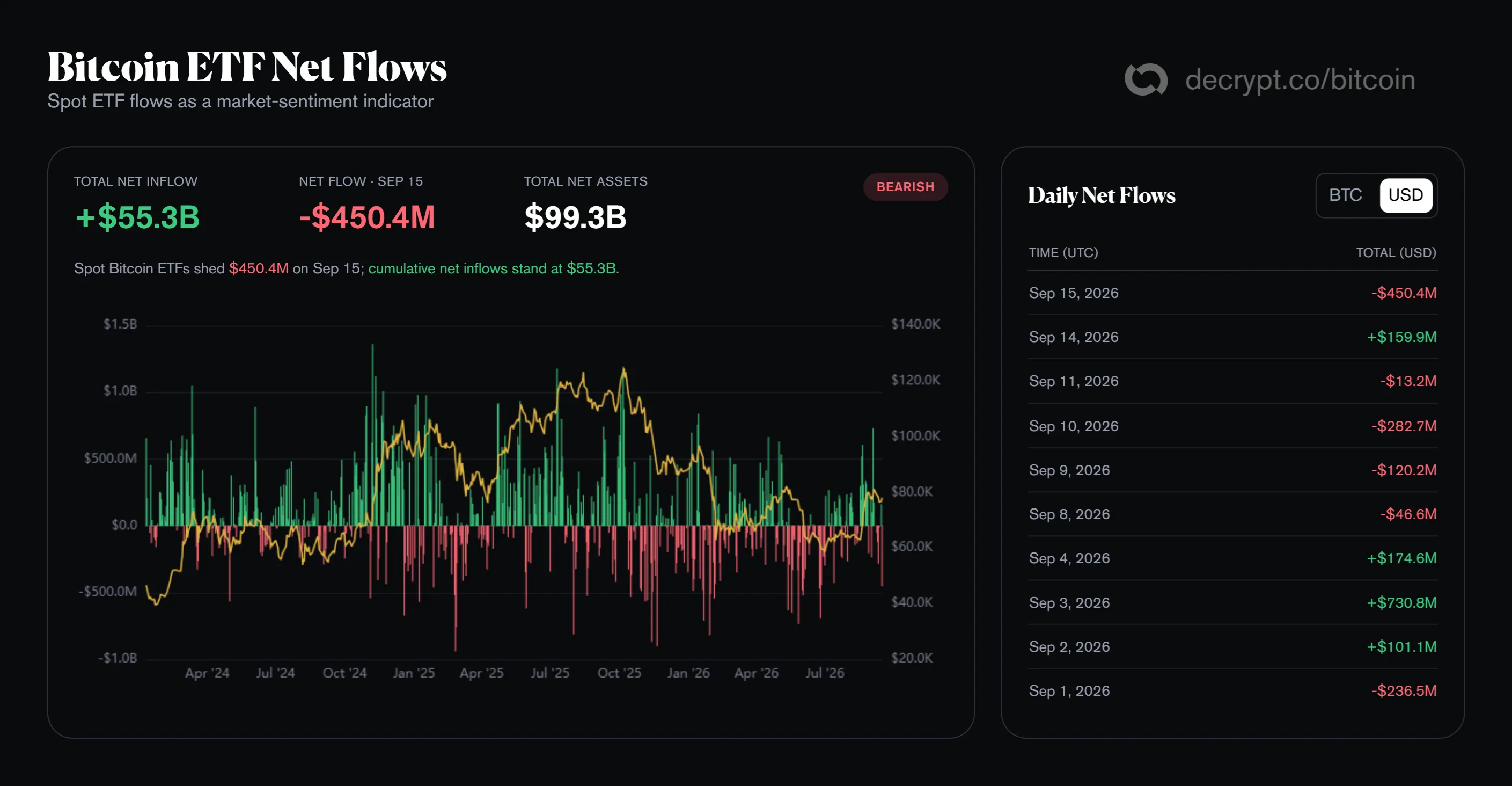
U.S. spot Bitcoin ETFs shed $450.4 million Tuesday, their largest single-day outflow since June 24.
The Senate voted 49 to 50 against invoking cloture on the Clarity Act, a crypto market-structure bill that needed 60 votes to advance, effectively ending its chances in 2026.
Ethereum ETFs lost another $142.3 million the same day, while XRP funds stayed flat.
U.S. spot Bitcoin ETFs shed $450.4 million on Tuesday, their largest single-day outflow since June 24, according to Decrypt's Bitcoin ETF tracker.
ETFs, or exchange-traded funds, are products that let ordinary investors buy exposure to an asset, such as Bitcoin, through a regular brokerage account, without ever touching a crypto wallet. They’ve been extremely popular since first launching two years ago and have become a proxy for overall market sentiment as money flows in and out of them daily.
Fidelity's FBTC led the exodus Tuesday with $214.8 million pulled out. BlackRock's IBIT lost $161.7 million, Grayscale's GBTC shed $44.1 million, and ARK 21Shares and Bitwise's funds saw smaller withdrawals.
Combined, the three asset funds lost close to $593 million in a single session—the sharpest one-day pullback crypto ETFs have seen since June, when Bitcoin funds posted their worst month on record.
The trigger wasn't a hack or a market crash. It was, apparently, Congress.
Why the Senate vote mattered
The Senate failed Tuesday to invoke cloture—the procedural vote that lets a bill move to formal debate, requiring 60 of 100 votes—on the Digital Asset Market Clarity Act.
Senators voted 49 to 50 against it. Senate Banking's ranking Democrat, Elizabeth Warren, opposed the bill on the floor, warning it would spark a "crypto-fueled economic crash."
The Clarity Act would have given crypto its first real rulebook, splitting oversight between the Securities and Exchange Commission and Commodity Futures Trading Commission and effectively legalizing most crypto trading in the United States.
Sen. Cynthia Lummis (R-WY), the bill's lead negotiator, called Tuesday's failure a likely death sentence: "It's over," she said just prior to the vote. Once the failed vote was confirmed she attacked her colleagues on the other side of the aisle. “The Democrats are now anti-American. Sad,” she posted on X.
This afternoon, Senate Democrats proved they were never truly serious about protecting consumers and preserving American leadership. I sat at the table with Senate Democrats working in good faith to get this done while they played games.
Regulatory clarity is what lets pension funds and banks treat Bitcoin like a normal, legal financial product instead of a legal gray zone. Without that clarity, institutional money tends to sit on the sidelines. Tuesday's outflows may be a sign of that hesitation showing up in real dollars. That said, today's forthcoming Federal Reserve decision, widely believed to be the first interest rate hike in three years, may be just as much—if not more—of a factor at the moment.
It's also worth noting that Congress isn't necessarily done trying on the Clarity Act. About 22 working days remain on the Senate calendar before midterm campaigning consumes the fall session, and the Digital Chamber, a crypto trade group, called Tuesday's result a "setback" rather than a defeat.
Barring a late revival, the SEC and CFTC's own rulemaking process—the fallback Treasury Secretary Scott Bessent has already pointed to—is now the closest thing U.S. crypto markets have to a regulatory roadmap for the rest of 2026.
Daily Debrief Newsletter
Start every day with the top news stories right now, plus original features, a podcast, videos and more.