





In brief
- Senators voted down cloture on the motion to proceed to the Clarity Act.
- The vote concerned a procedural step toward considering the bill, not final passage.
- Today's result followed months of negotiations over crypto ethics rules and stablecoin rewards.
The U.S. Senate on Tuesday failed to clear a key procedural hurdle for the Clarity Act, setting back efforts to establish a federal framework for crypto markets.
In a 49 to 50 vote, Senators voted to reject cloture on the motion to proceed—a step that limits debate on whether to take up the legislation and requires 60 votes.
All Democrats present, including Sens. Elizabeth Warren and Elissa Slotkin, voted no, alongside Republican Sens. Susan Collins, Josh Hawley, and Jerry Moran. Republican Sen. Thom Tillis initially voted yes but switched to no for procedural reasons. Most Republicans, including Sens. Tim Scott and Cynthia Lummis, voted to advance the bill.
The vote concerned cloture on the motion to proceed—a step toward taking up the crypto market structure bill, rather than a vote on final passage.
The Clarity Act would establish rules for crypto markets, essentially legalizing most crypto activity in the United States, and clarify the respective responsibilities of the Securities and Exchange Commission and Commodity Futures Trading Commission.
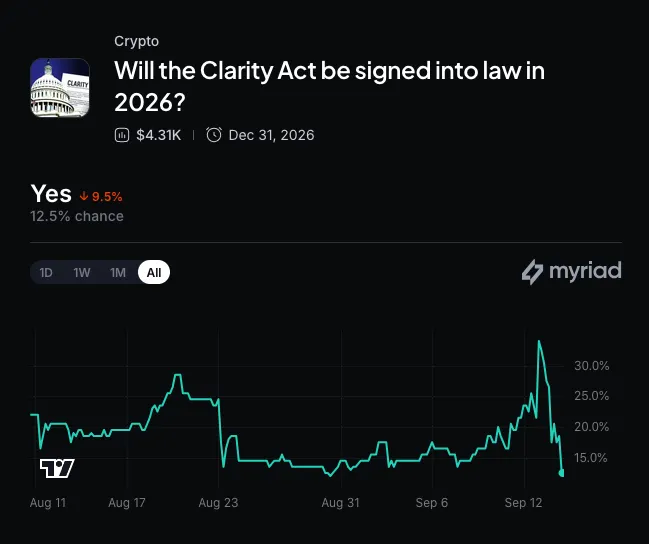
Tuesday's result effectively blocks further consideration of the Clarity Act in the Senate. And, according to the bill's biggest supporter in Congress, Wyoming Senator Cynthia Lummis, today's failure to reach cloture means the bill is all but dead. "It's over," she said earlier today.
The vote followed a delay until after the Senate's August recess, as lawmakers negotiated disputes over stablecoin rewards, safeguards against illicit finance, and ethics restrictions covering President Donald Trump's crypto interests.
Lawmakers released another version of the Clarity Act over the weekend, revising the ethics language addressing public officials' crypto interests ahead of Tuesday's vote. Restrictions covering Trump's crypto holdings have been a central issue in negotiations over Democratic support.
Republicans said the updated text, which they called their "last, best and final" offer, incorporated 126 substantive changes requested by Democrats, including major revisions on ethics, software developer protections and the Ag title, plus a new "circuit breaker" meant to address concerns that stablecoin yield could pull deposits from community banks.
The revised ethics language, which Trump signed off on, would require covered officials to divest crypto interests or place them in a qualified blind trust, allow state attorneys general to help enforce the restrictions, and expand the definition of covered officials to include those elected but not yet sworn in, as well as their spouses. Unlike an earlier draft, it carries no sunset date.
But Democrats weren't satisfied. Late Monday, they sent Republicans a counteroffer seeking additional restrictions on large crypto holdings, dependent children and paid crypto promotions, along with further changes to the Blockchain Regulatory Certainty Act and the Ag title, according to two people familiar with the proposal.

Republicans balked. "In response to a significant step in their direction, Democrats have chosen to move the goalposts again," Senate Banking Committee spokesperson Jeff Naft said in a statement, adding that the party was making "the same unreasonable asks."
White House Crypto Council Executive Director Patrick Witt told Crypto In America there was little room left to negotiate, saying any remaining changes amounted to "punctuation" or technical fixes. Sen. Kirsten Gillibrand (D-NY), meanwhile, privately urged fellow Democrats to vote to advance the bill and keep negotiating on the floor, Politico reported.
Stablecoin rewards have been another sticking point. Banks have pushed for tighter restrictions on the payments, arguing that they could draw deposits away from lenders. Crypto companies have pushed back, with Coinbase CEO Brian Armstrong arguing that banks are seeking to suppress competition from stablecoins.
Ahead of the vote, eight banking trade groups, including the American Bankers Association, rejected the new circuit breaker as "not a safeguard at all" because it would activate only after substantial deposit flight had occurred, while the White House Council of Economic Advisers launched a tool disputing the banks' deposit-flight argument.
What happens next
The failed vote blocks this attempt to advance the Clarity Act, but Senate leaders could bring it back for another vote. Doing so would require enough support to overcome the procedural obstacle that stopped it Tuesday. It would also need to overcome a shortened Senate calendar, with Congress facing roughly three weeks of working days before the fall session turns to midterm campaigning.
Even if senators revive and pass the revised bill, it would need to then return to the House, because the Senate proposal changes the version representatives previously approved. Both chambers must agree on identical text before sending the legislation to President Trump.
Leading up to the vote, the CFTC said it was rolling out its own crypto rules using powers it already has. CFTC Chair Michael S. Selig directed staff to explore those rules, though he favors legislation to make the framework harder for future administrations to reverse.
Editor's note: This story was updated after publication to provide further details on today's vote.