






In brief
- Strategy repurchased 1,420,467 shares of its STRC preferred stock for $139.3 million between September 8 and 13, funded entirely from its USD Cash reserve.
- The company bought no Bitcoin for a second straight week, holding steady at 845,050 BTC acquired for $63.73 billion at an average of $75,412 per coin.
- Roughly $1.05 billion remains under Strategy's $2 billion digital credit securities repurchase program, alongside $1 billion still available for MSTR stock buybacks.
Strategy repurchased 1,420,467 shares of its STRC preferred stock for $139.3 million in the week to September 13, according to an 8-K filed with the Securities and Exchange Commission on Monday.
That pulled back from the $176.3 million the Bitcoin treasury company spent the previous week, when its board doubled the authorization behind its digital credit securities repurchase program to $2 billion. Every dollar came out of USD Cash, the liquidity pool management taps for buybacks, dividends and Bitcoin purchases alike.
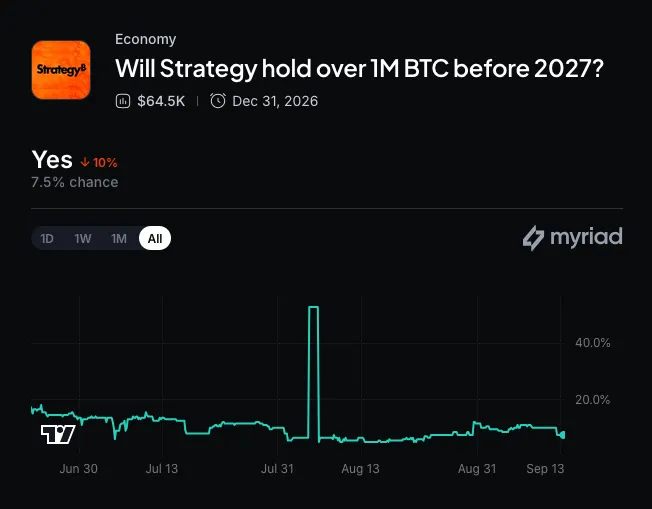
The company bought and sold no Bitcoin during the period, leaving its holdings unchanged at 845,050 BTC for a second consecutive week. Strategy acquired that stack for $63.73 billion at an average price of $75,412 per coin, inclusive of fees.
Strategy repurchased none of its STRF, STRK, or STRD preferred shares, and bought back no MSTR common stock either. About $1.05 billion remains available under the $2 billion digital credit securities program, while a separate $1 billion authorization for MSTR stock sits untouched.
The company's dollar balances stood at $5.10 billion in the USD Reserve, which backs preferred dividends and interest payments, and $1.30 billion in USD Cash as of September 13. That's down from $1.44 billion a week earlier, tracking almost exactly with the $139.3 million spent buying back STRC.
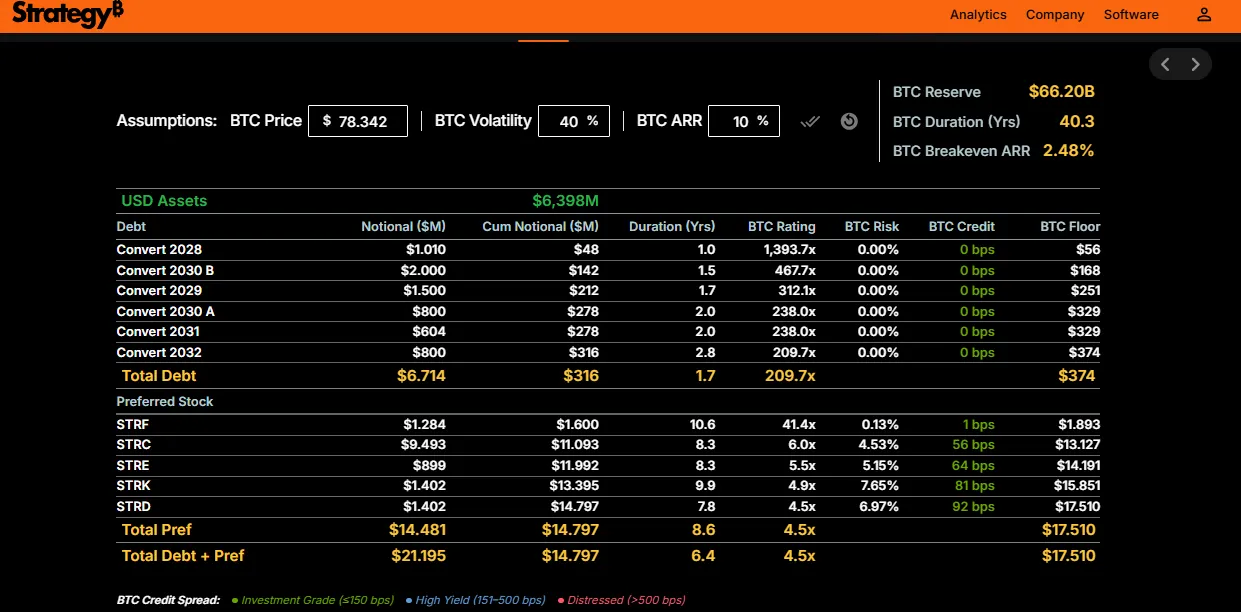
Per Strategy's own credit dashboard, STRC's BTC Credit spread—the risk premium implied by pricing the security against Strategy's Bitcoin collateral—sits at roughly 57 basis points, assuming a 10% annualized Bitcoin return, 40% volatility and Bitcoin near $77,266.
That keeps the security in investment-grade territory on Strategy's own scale, which flags anything under 150 basis points that way. The same dashboard puts Strategy's aggregate Bitcoin reserve at $66.2 billion against a blended breakeven annualized return of 2.48%, with a duration of 40.3 years.
To put this in simple terms, a basis point is basically a way for finance experts to talk about tiny percentages—one basis point is equal to 0.01%, so 57 basis points is 0.57%. Think of the "Bitcoin Credit spread" as a safety gap: it represents the extra cost or risk associated with this investment compared to a safer investment.
Strategy has a rule that as long as this risk stays below 150 basis points (1.5%), they consider the investment very safe, or "investment-grade."
The breakeven return of 2.48% is the minimum amount Strategy needs their Bitcoin to grow each year to cover their costs, and the 40.3-year duration means they have a very long time to reach that goal, giving them a massive cushion against short-term price drops.
So, at least on paper, things look OK, especially if Bitcoin keeps going up.
The buyback slowdown comes as Strategy awaits word on an MSCI proposal that could strip "non-operating companies" like Strategy from its global equity benchmarks.
Feedback on that consultation closes September 30, with a decision due October 16 — a date that could move billions of dollars in passive fund flows tied to Strategy's index weighting.