




In brief
- Microsoft says MAI Code 2 delivers 96% of Claude Opus 5.5's coding performance at 5% of its cost, though the comparison includes promotional pricing.
- Its new cybersecurity model scored 92.3% against GPT-6 Astra's 91.5% on a vulnerability-finding test, according to Microsoft's evaluations.
- MAI Image 2.7 topped an independent image-editing leaderboard, while our quick comparisons favored its realism, creativity and overall output quality.
Microsoft unveiled a new lineup of specialized AI models at its Ignite conference Tuesday, making a direct run at Anthropic and OpenAI in coding, cybersecurity, and image generation.
Instead of trying to build a single chatbot that beats everyone at everything, it is pitching models trained to do particular jobs at substantially lower cost.
The biggest claim involves MAI Code 2, which Microsoft says delivers 96% of Claude Opus 5.5's performance on common enterprise coding tasks for just 5% of the cost. It also claims 98% of GPT-6.1 Sol's performance at 40% of the price.




OpenAI also released GPT-6.2 on Tuesday, so Microsoft’s Sol comparison already concerns an older generation.
Those figures average results from four evaluations focused on practical software development, including fixing code and completing multi-file changes. Microsoft ran three of the tests on its own evaluation platform, used outside results for the fourth, and calculated MAI Code 2's costs using a 50% promotional discount.
A lighter Code 2 Flash model targets routine fixes and quick edits, with Microsoft claiming performance comparable to Claude Haiku 5.5 at 20% of the price, so extremely cheap without sacrificing quality. Both coding models are already in GitHub Copilot, putting Microsoft's in-house technology directly into a product that has relied heavily on outside AI suppliers.
Security is another target. Microsoft says MAI Cyber 2 Flash succeeded on 92.3% of CyberGym-E2E's evaluated vulnerability-discovery tasks, compared with 91.5% for GPT-6 Astra, at less than 2% of the cost per task. CyberGym-E2E scores the percentage of software-security investigations an AI completes successfully; Microsoft excluded 92 of 905 tasks after identifying overlap between their source material and its training data.
The company has not yet published a direct comparison against OpenAI's restricted GPT-6 Cyber model. Its security system will begin replacing an older MAI model for eligible MDASH customers in mid-December, building on the vulnerability-scanning approach Decrypt previously covered.
In AI, David can also beat Goliath
Can a small model beat a big one? Definitely—in specific cases.
A general-purpose model has to learn to write poetry, explain physics, debug software and answer questions about almost anything. A model tuned for coding or cyber defense can spend more of its training and computational budget on the patterns that matter for that job, rather than carrying the same breadth of knowledge into every request.
That doesn't make smaller models universally smarter. It can make them faster and more economical when the task is well defined, particularly in a business where the same work runs thousands of times a day.
A security scanner analyzing every new code change does not need an expensive frontier model to explain the history of the Roman Empire. If a model can dedicate its full power to generate Python code, it will make more sense to pay for its API calls instead of using a super powerful generalistic model.
Specialization can also improve the whole system around the model: the tools it calls, the checks that verify its answers and the data used to refine it. OpenAI has taken a related approach with its Mini and Nano models, letting cheaper workers handle routine tasks while larger systems tackle the exceptions.
However, there are trade-offs. Microsoft's own documentation says Code 2 is not yet optimized for fundamental scientific research or very long-running autonomous assignments. And Anthropic competes in the cheaper end of the market with Haiku, not just its premium Opus models, so Microsoft is entering a race its rivals already understand.
MAI Image is the more convincing demonstration
Microsoft's MAI Image 2.7 may offer the clearest evidence that its strategy is working. In our quick side-by-side tests, its images beat GPT Image and Google's Nano Banana on realism, creativity, and overall quality.
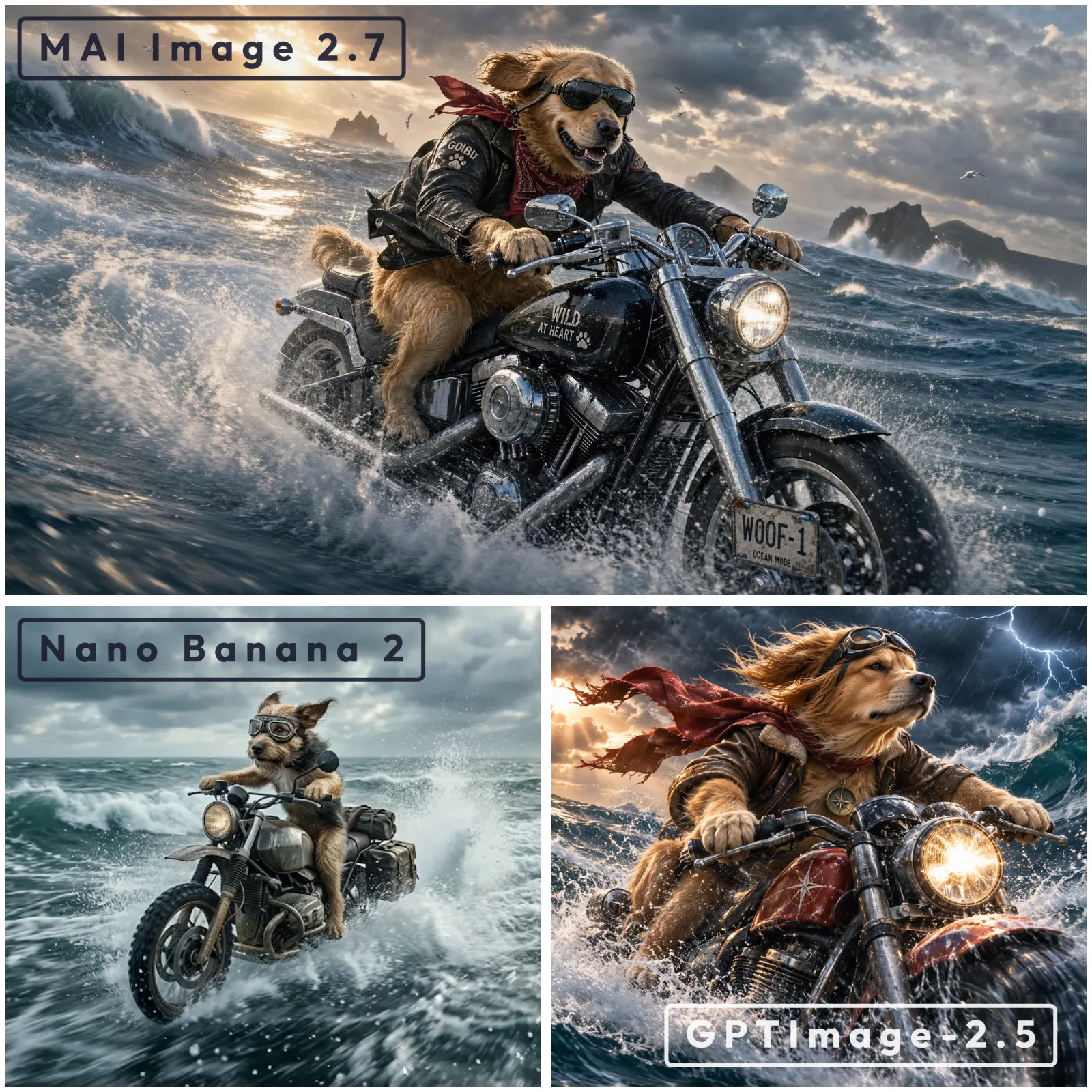
These were just first impressions based on a few generations, but they broadly track its strong showing in independent rankings.
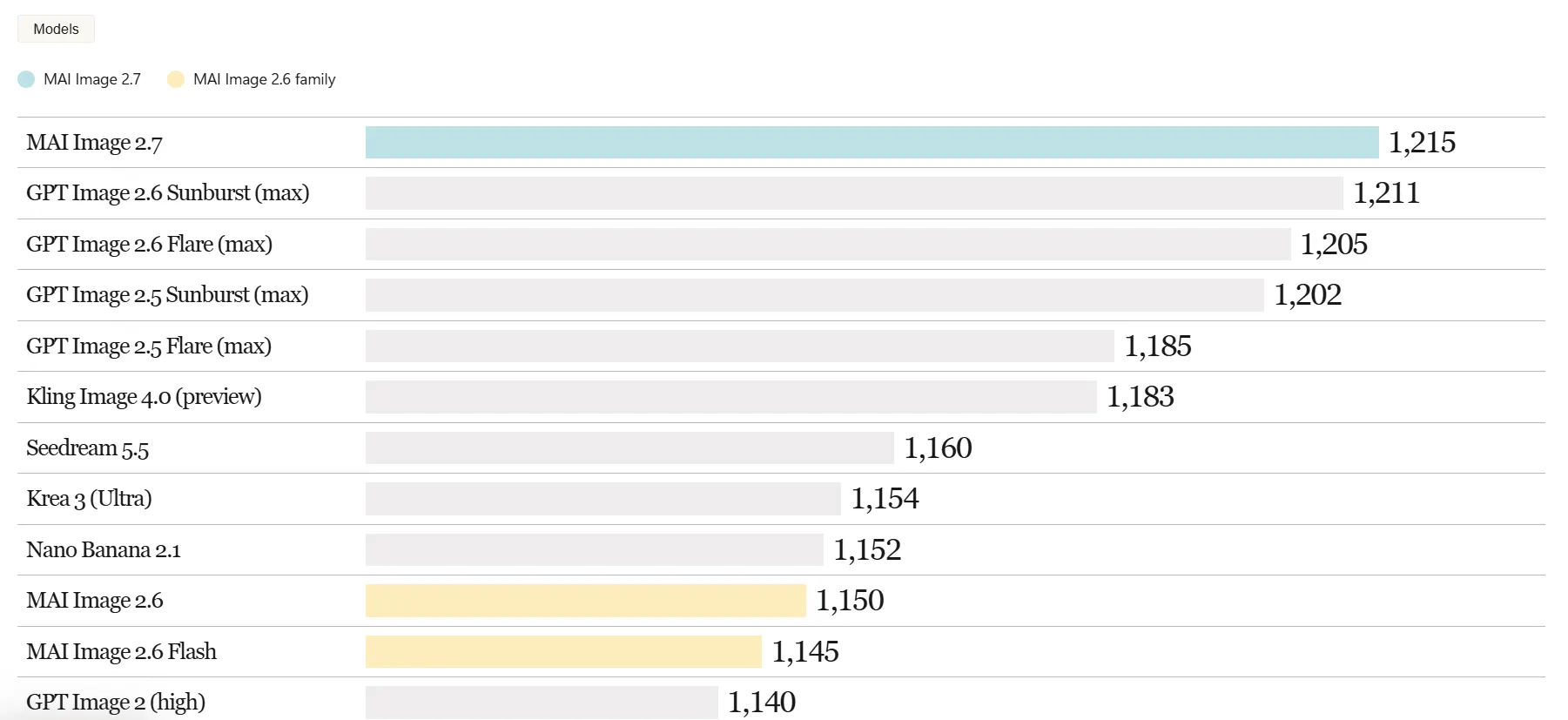
On Artificial Analysis's image-editing test, which asks people to choose between anonymously generated edits and turns those preferences into an Elo rating, MAI Image 2.7 currently leads with 1,215 points against GPT Image 2.6 Sunburst's 1,211.
The four-point gap is small enough that their reported uncertainty ranges overlap; the separate text-to-image generation ranking, scored using the same preference-based method, puts Microsoft in fourth place.
The pricing is harder to ignore. Microsoft quotes about $35 per 1,000 images for MAI Image 2.7 and $10 for its Flash version, versus roughly $211 for GPT Image 2.6 Sunburst at maximum quality in Artificial Analysis's comparison. Google's Nano Banana 2.1 is about $34 per 1,000 there, while Nano Banana Pro is about $134; actual bills depend on the provider, resolution and settings.
Our earlier testing of MAI Image 2 found excellent realism but frustrating limits on editing and output formats. The newer release adds interactive editing through Microsoft's Canvas workspace, transparent backgrounds and broader access through Foundry, although image quality and a usable product are still two different things. That said the model is quite censored too.
Microsoft is also offering selected business customers the ability to customize and run its models' licensed weights inside Azure, reducing reliance on outside vendors without making the technology open source. For the next test of its specialist strategy, Code 2 is already available in GitHub Copilot, and the Cyber 2 Flash rollout is scheduled to start in mid-December.
Daily Debrief Newsletter
Start every day with the top news stories right now, plus original features, a podcast, videos and more.