




In brief
- The UK's Labour Party and Liberal Democrats have separately written to regulators calling for an investigation into whether the Reform UK has accepted crypto donations.
- The Liberal Democrats’ letter also urges scrutiny of whether a conflict of interest may have arisen when Reform’s Nigel Farage promoted Tether, which is partly owned by its biggest donor.
- Nonprofits are also calling for electoral reform that may set limits on donations from individuals.
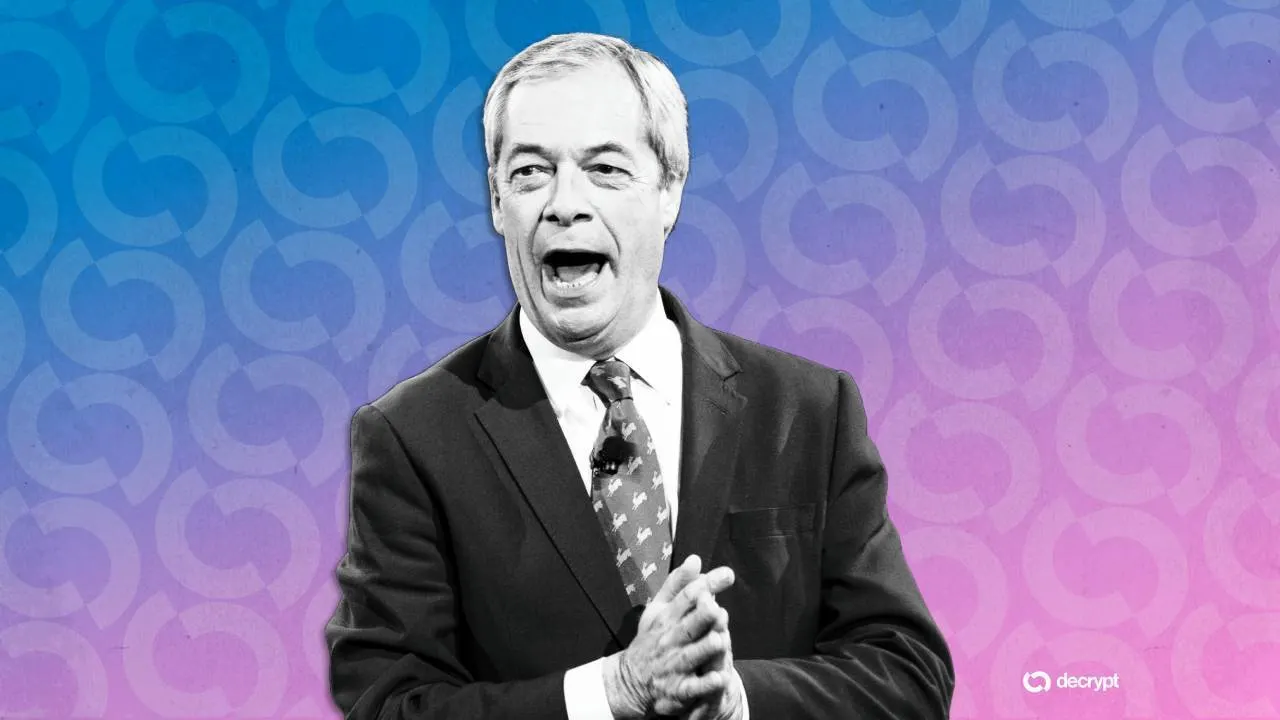
Political parties in the UK have called for the electoral regulator to investigate after British crypto billionaire Christopher Harborne donated £9 million ($12 million) to Nigel Farage’s Reform UK.
The Liberal Democrats and the Labour Party have separately written to the Electoral Commission to request an investigation into the donation, which was the largest ever made in the UK by a living individual.
The Labour Party has also called on the Financial Conduct Authority to look into the matter, having sent the financial regulator a letter in which it called on Reform’s Nigel Farage to provide more details on whether it has received crypto donations.
Reports suggested that Reform received the UK’s first-ever crypto donation in October, although no declaration has been made to the Electoral Commission.
Reform UK has clarified that the $12 million donation from Harborne was not made in crypto, although much of Harborne’s wealth derives from his 12% stake in Tether and Bitfinex.
Harborne previously donated a total of £13.7 million to Reform—then branded as the Brexit Party—between 2019 and 2020, while he also donated £1 million ($1.33 million) to former Prime Minister Boris Johnson in November 2022.
In its letter to the Electoral Commission, the Liberal Democrats focused on potential conflicts of interest, given that Nigel Farage and his party have publicly voiced support for cryptocurrencies, and given that Harborne is so heavily invested in the industry.
In the letter, Lib Dem MP Lisa Smart said, “There is a disturbing possibility that Reform was in possession of Tether when Mr Farage promoted the coin,” presumably referring to an appearance on the LBC radio station in September in which Farage talked positively about Tether.
Nigel Farage publicly promoted cryptocurrency Tether, and then received a massive donation from one of its major investors. The whole thing stinks.
That’s why @LisaSmartMP has written to the electoral commission calling for an urgent investigation. ⬇️ pic.twitter.com/IjevvWDaoY
— Liberal Democrats (@LibDems) December 8, 2025
Smart went on to say that, “Given the scale of the donation and the prominence of the political figure involved, I believe this matter warrants the scrutiny of your office to determine whether [...] A conflict of interest existed or may have existed [...] Any rules on lobbying, influence, or the acceptance and declaration of donations may have been breached”.
Aside from the possibility of any conflicts of interest, other figures are concerned that the donation is a symptom of how individual donors are having an increasingly disproportionate influence on the UK political system and process.
“UK democracy is increasingly reliant on a small number of extremely wealthy donors,” said Steve Goodrich, the Head of Research and Investigations at Transparency International UK.
Speaking to Decrypt, Goodrich said that overreliance on rich donors “increases the chances of quid pro quos,” with benefactors given “privileged” access and influence.
However, he held out hope that an elections bill will “protect democracy by strengthening the rules around donations to political parties,” as the ruling Labour Party promised in its 2024 manifesto.
He said, “The forthcoming Elections Bill presents an opportunity to remove the corrupting influence of big money from politics – a reform that commands widespread public support.”
Reform UK has been contacted for comment.