





In brief
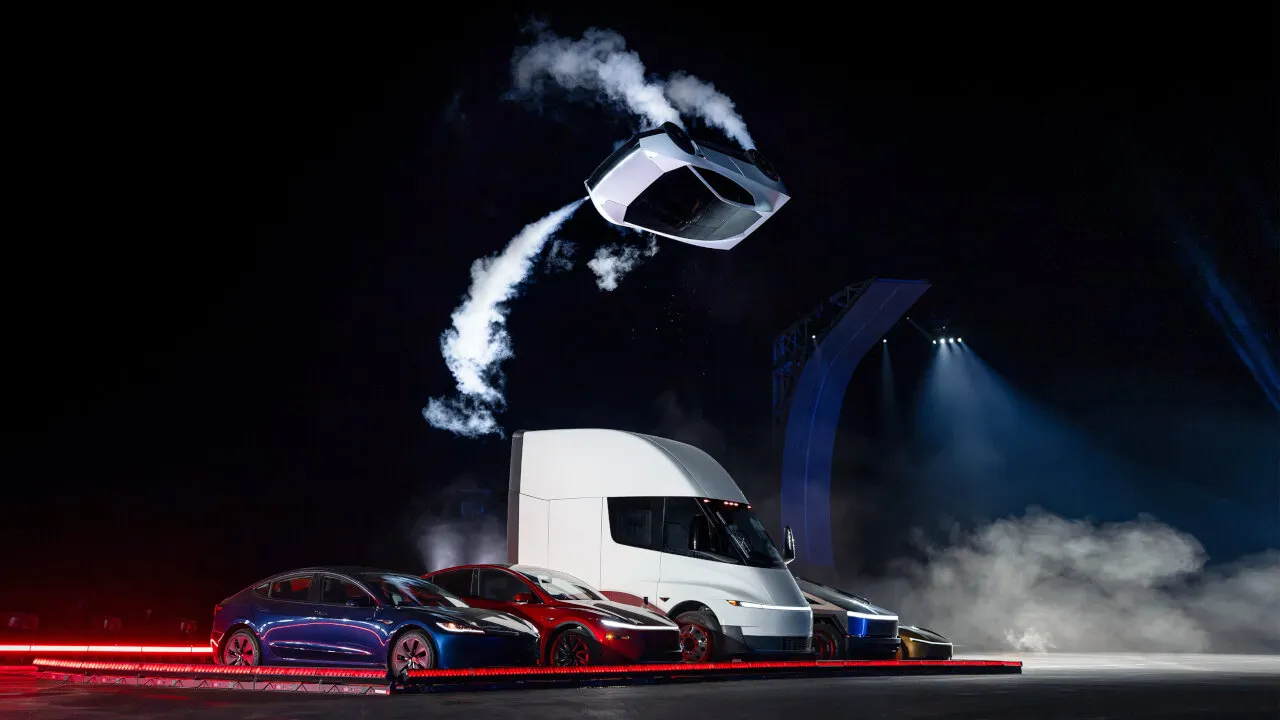
- Tesla showed a new Roadster on October 15 that drove up an inverted ramp, flipped in midair, and landed on its wheels using cold-gas thrusters developed with SpaceX.
- Reservations are $50,000 for the Performance and $250,000 for the Thrust, while the single-seat Rocket is invite only; Musk says production begins in 2028.
- Tesla's website says the flying version is not approved for public road use, and no FAA or road-safety approval has been reported.
Tesla's new Roadster drove up an upside-down ramp, flew off the end, flipped in midair, and landed on its wheels. The livestreamed demo took place October 15 at a SpaceX test site in Texas, where the car also hopped over a row of Teslas that included a Semi truck.
The stunt drew oohs and aahs on social media, especially on X where the announcement gathered over 10 million views.
Even Musk’s former-friend-turned-foe Sam Altman praised it on X, “Wow the new roadster looks quite amazing, good job.” That is a generous take from a guy who reserved a Roadster in 2018 and had to wait 7.5 years to get a refund.
Almost everyone is talking about it, and almost no one who is will get to own one any time soon (if ever).
Real life, baby pic.twitter.com/3QEqn18wig
— Tesla (@Tesla) October 16, 2026
The trick that makes this car fly is cold-gas thrusters, which are basically compressed air blasted out of nozzles instead of burned rocket fuel. Lars Moravy, Tesla's vice president of vehicle engineering, said 10 thrusters connect to 600 liters of compressed air, and that Tesla borrowed some technology from SpaceX to pull it off.
On paper the car reports a top speed above 230 mph, more than 300 miles of range, and 0-60 mph in under a second. The on-stage test clocked 0.81 seconds, and Tesla lists the single-seat Rocket at under 0.59.
Musk had been teasing this since last October, when he told Joe Rogan the next Roadster could be capable of flight and was “crazier than all the James Bond cars combined.” Tesla now bills it as “the best of the last human-driven cars.”
Tesla has not announced a price for any version, but its reservation page asks $50,000 for the two-seat Performance and $250,000 for the Thrust, with $5,000 due up front and the balance within 10 days.
The Rocket, the version built around a full flight system, seats one, has no listed figure, and is invite only. Musk said production begins in 2028.
So, you will need to be among the chosen few to get your hands on one of these cars.

 →
→Tesla's own website says the flying version is not approved for public road use, and when Musk was asked whether the car is street legal, he said it “depends on your street.” No FAA or road-safety approval for it has been reported, so even with an invitation in hand you would not be taking it to the office.
Making a flying car legal likely takes at least two regulators: U.S. carmakers self-certify that vehicles meet federal safety standards, while an aircraft needs an FAA airworthiness certificate, and the agency says certifying a new aircraft type can take between five and nine years.
It’s hard to check history when it comes to flying cars. One of the closest precedents is Alef Aeronautics, whose Model A precursor received an experimental airworthiness certificate from the FAA in June 2023 that allows flight testing and was billed as a step toward a type certificate.
Minnesota's Jetsons law lets residents own a roadable aircraft but bans taking off and landing on public roads, following a 2020 New Hampshire law that gave private citizens the right to own flying cars.
So you’ll likely need a special license to drive a car that also counts as an aircraft.
Hovering is the other obstacle: a 2021 paper in Joule puts the power an electric aircraft needs to hover at 500 to 900 watts per kilogram, against 150 to 350 in cruise.
In plain terms, the battery has to dump energy far faster than it does on a normal flight. Tesla's cold-gas approach sidesteps that, which is likely why the demo showed jumps and a flip instead of a trip from one place to another.
Daily Debrief Newsletter
Start every day with the top news stories right now, plus original features, a podcast, videos and more.
Join 72,000+ readers