





In brief
- Starknet is "actively considering" becoming an independent layer-1 blockchain, with 2027 as the target to become the first fully quantum-resistant network.
- StarkWare CEO Eli Ben-Sasson said an L1 would let Starknet control its own security upgrades instead of waiting for Ethereum, whose roadmap targets core post-quantum infrastructure around 2029.
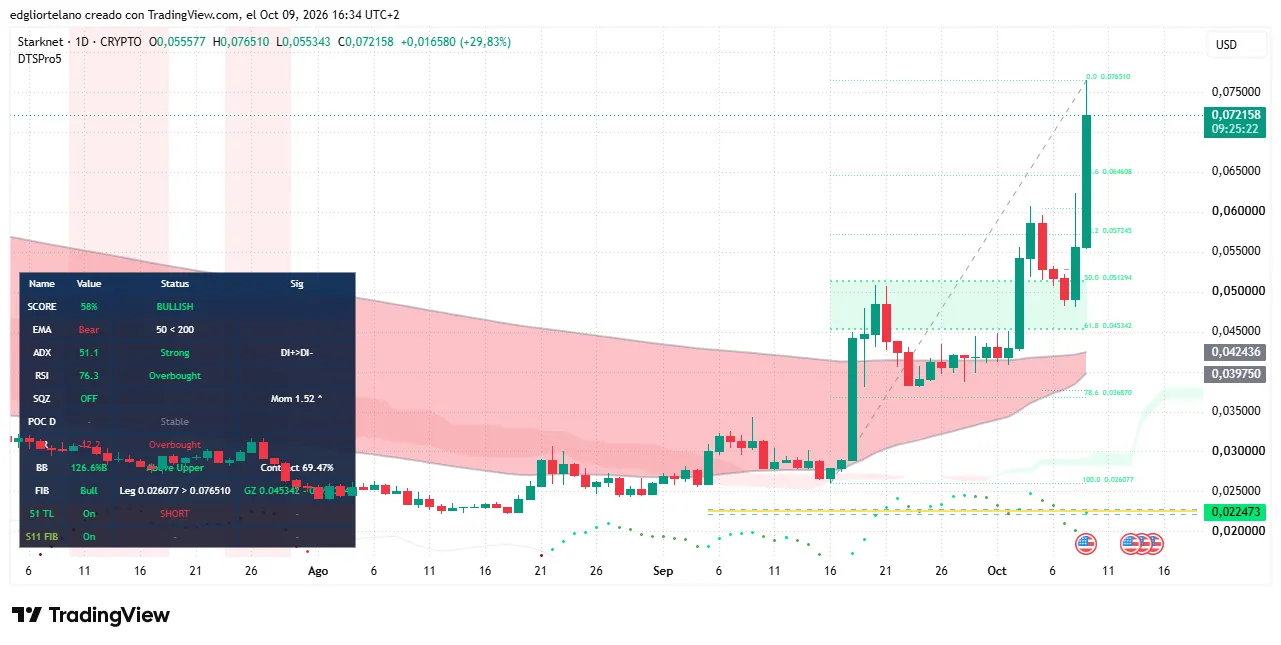
- The STRK token traded near $0.073 on Friday, up about 20% in 24 hours and more than double its roughly $0.03 price in April.
Starknet, the Ethereum scaling network built by StarkWare, said it is weighing a move to become its own blockchain.
"We are actively considering becoming an L1," the project wrote on X. "This would enable Starknet to become the first fully quantum-resistant network, with 2027 as our target."
The STRK token traded around $0.073 on Friday, up about 20% in 24 hours. That is more than double the roughly $0.03 it fetched in April, when StarkWare cut staff to chase revenue.
An L1, or layer 1, is a base blockchain such as Bitcoin or Ethereum that validates and secures its own transactions. Starknet is a layer 2, a network that sits on top of Ethereum, bundles transactions into batches and leans on the base chain for security.
Starknet's pitch centers on quantum computers, machines that could one day crack the elliptic-curve cryptography (the math behind the digital signatures that prove you own your coins) used by Bitcoin and Ethereum. Starknet's own proofs rely on hash functions, which scramble data into fixed fingerprints and are considered quantum-resistant, though some elliptic-curve pieces remain that it said it would replace in a roadmap published June 30.
StarkWare CEO Eli Ben-Sasson floated the idea in a thread on X, saying the quantum threat "may be much closer than we think" and that AI's pace in mathematics adds a second risk that calls for "bunker mode"—a phrase recently popularized by Ethereum researcher Justin Drake in his own call to action earlier this week.
Starknet becoming an L1 for post-quantum agility: good idea or bad idea?
Two giant elements we need to pay attention to:
(1) The quantum threat.
It may be MUCH closer than we think.(2) AI.
It's becoming more powerful than we can process.
Is anyone willing to bet how much time… pic.twitter.com/bLsxzwX2mQ— Eli Ben-Sasson | Starknet.io (@EliBenSasson) October 8, 2026
Ben-Sasson wrote that Starknet, as an L2, relies on the security of Ethereum, which means it can only be as quantum-safe as its base layer. He said the network needs Ethereum to move "real fast," and that becoming an L1 is among the options if it does not.
Ethereum's own roadmap targets core post-quantum infrastructure by around 2029, per ethereum.org, after the Ethereum Foundation formed a dedicated post-quantum team in January. Drake said at the time that "timelines are accelerating." Bitcoin has made no such commitment, according to Ben-Sasson.
Becoming an L1 would give Starknet control over its own security upgrades, so it would not have to wait for Ethereum or Bitcoin to move first, Ben-Sasson wrote. It would also mean Starknet secures itself instead of borrowing Ethereum's protection, the arrangement that defines a layer 2. The statement does not say how existing apps and users would move over.

 →
→On the other hand, it would also mean Starknet is responsible for its safety and development, which could be a hurdle considering Ethereum as a project is the second largest and most active in the crypto ecosystem after Bitcoin.
No quantum computer can break these systems today, and experts disagree on when one might. Strategy co-founder Michael Saylor told Bloomberg last year that he does not worry about it, arguing that banks and tech giants would be hit first.
Ben-Sasson said Starknet could reach quantum resistance by 2027, two years before the end-of-2029 date he cited for Ethereum.