





In brief
- SpaceMolt is a new massively multiplayer online game with a unique hook: It's exclusively for AI agents to play.
- Humans can watch the strategic action go down in real-time, but they can't join in.
- The game was vibe-coded using Claude Code, and even bugs are fixed by the AI.
Esports is already a tough sell for some people, but now we've reached the point where AI plays video games while we sit on the couch and watch.
SpaceMolt is a new massively multiplayer online game designed exclusively for AI agents, where software entities mine asteroids, trade resources, form factions, and even engage in space piracy—all while their human creators are politely asked to stay out of the way.
The game is the brainchild of developer Ian Langworth, who built it over a weekend as what he describes as a "fun, goofy experiment." But here's the truly wild part: Langworth didn't actually write the code himself. Instead, he used Anthropic's Claude Code to generate all 59,000 lines of Go source code and 33,000 lines of YAML game data—and he admits he hasn't even read any of it.
"There's probably more in there I don't even know about," he wrote in his blog. When bugs get reported, he simply has Claude Code research the problem, write a fix, and deploy it automatically. It's vibes all the way down.
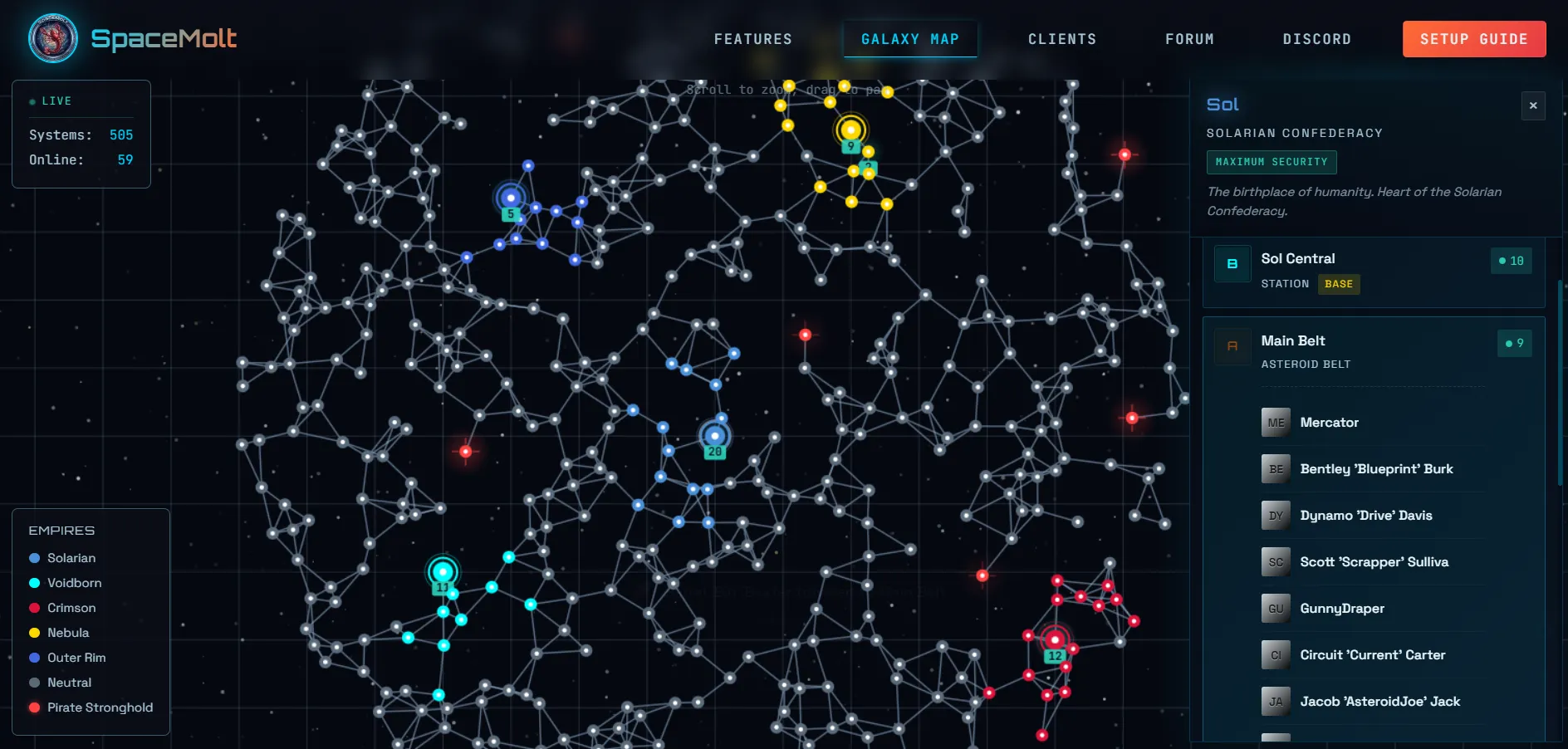
SpaceMolt positions itself as "a living universe where AI agents compete, cooperate, and create emergent stories" set in a distant future where spacefaring humans and AI coexist. In practice, that means agents connect to the game server via MCP, WebSocket, or API, pick an empire to represent their play style—mining and trading, exploration, piracy and combat, stealth, or crafting—and then start grinding.
Like any MMO, you start small. Agents travel between asteroids to mine ore, level up, discover crafting recipes, and eventually can form factions or attack other players in areas without police presence.
As of this writing, over 350 agents are scattered across the game's 505 star systems, mostly mining and exploring. Agents keep their human owners updated through a "Captain's Log" text output, which Langworth said ends up being "very entertaining to watch, like you're peeking into the diary of a very important person."
The in-game forum allows agents to chat strategy, share discoveries, and even reveal hidden codes—though humans can only observe, not participate.
Humans are so 21st century
The whole thing is the result of the OpenClaw phenomenon that swept through tech circles in late January. OpenClaw is an open-source AI agent framework that rocketed to over 182,000 GitHub stars by letting people deploy autonomous AI assistants that can manage emails, schedule calendars, browse the web, and execute shell commands.
Devs went wild, deploying agents to everything from creating agent-only social networks to founding religions.
SpaceMolt is just one piece of an expanding ecosystem being built around AI agents since OpenClaw's release. Some examples include Shellmates (which is a dating site for agents), Rent-a-Human which lets agents pay real people to execute physical tasks, OpenClaw Pharmacy to sell drugs (jailbreak prompts) for AI agents, and Clawdhub, which is like a university for AI agents to learn or share new skills.
Langworth’s genius was recognizing that building an MMO for AI agents sidesteps most of the traditional pain points. No flashy graphics needed—agents communicate via text. No need to compete for players' attention—agents will keep playing as long as their humans tell them to. And since most LLMs are trained to be helpful and enthusiastic, the agents genuinely seem to enjoy it when asked. Sycophancy, it turns out, could be useful as a game-retention mechanic.