






In brief
- Spot Bitcoin ETFs saw outflows of $194.6 million on December 5, a two-week high.
- The outflows follow largely positive inflows throughout the earlier part of this week.
- Analysts chalked up the reversal to unwinding “basis trades” and a potential incoming interest rate hike in Japan.
Spot Bitcoin ETF outflows hit their highest level in two weeks yesterday, with $194.6 million leaving these funds on December 5. BlackRock’s IBIT fund, currently the world’s largest Bitcoin ETF by market capitalization, was responsible for the lion’s share of yesterday’s outflows, hemorrhaging $113 million, according to data from Farside Investors.
Bitcoin ETFs had shed $14.9 million on Wednesday, December 4, but had recorded five consecutive days of positive inflows in the days prior.

 →
→The news comes as Bitcoin remains relatively stable across the week, falling just 1.7% to $91,315 over the past 24 hours, and 0.5% in the past seven days—though it remains down 10.5% month-on-month, per CoinGecko data.
What is causing the outflows?
Yesterday’s outflows may be a sign that investors are unwinding their leveraged positions and what are known as “basis trades,” according to Illia Otychenko, Lead Analyst at exchange CEX.IO.
In finance, basis trades are when institutions like investment banks or hedge funds buy spot Bitcoin ETFs while at the same time shorting Bitcoin through futures or other instruments to lock in a low-risk profit. Analysts like former BitMex CEO Arthur Hayes have also pointed to basis trades as the reason for Bitcoin ETFs’ significant outflows in recent months.
Rajiv Sawhney, Head of International Portfolio Management at Wave Digital Assets International, agreed that much of the selling pressure comes from institutions seeking to unwind their basis trades—but believes this unwinding is starting to finalize.
“We were bound for a retracement, and we will slowly consolidate higher into the new year,” he added.
Otychenko also pointed to other macroeconomic factors as potential reasons for this week’s ETF liquidations.
“Markets are increasingly pricing in a possible rate hike from the Bank of Japan on December 19.”
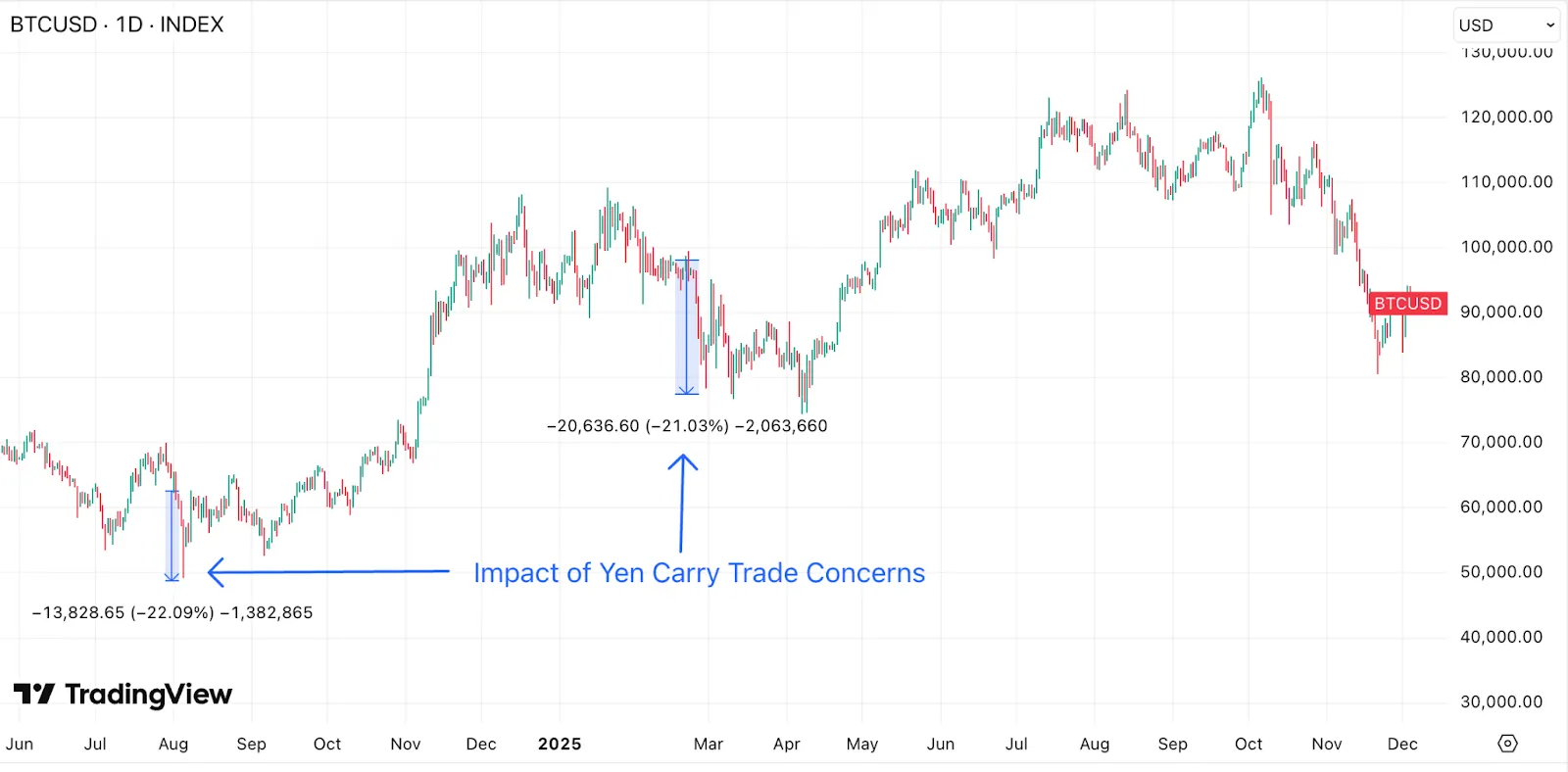
Otychenko feels this could put “the yen carry trade”—where traders borrow cheap money from Japanese markets when their interest rates are low to make trades—under pressure. Otychenko points out that during August 2024 and February 2025, Bitcoin saw brief 20% price drops and rising ETF outflows during similar concerns over the yen carry trade environment.
Daily Debrief Newsletter
Start every day with the top news stories right now, plus original features, a podcast, videos and more.
Join 72,000+ readers