




In brief
- Nvidia announced Jensen Huang’s resignation on Thursday and named CFO Colette Kress interim CEO; shares plunged at the opening bell.
- Binance founder CZ, Venice AI founder Erik Voorhees, and prominent AI builders criticized the departure, with some warning about the future of open-weight models.
- Claims of an anti-open-source conspiracy remain unproven, while Elon Musk said hiring Huang would be “an honor.”
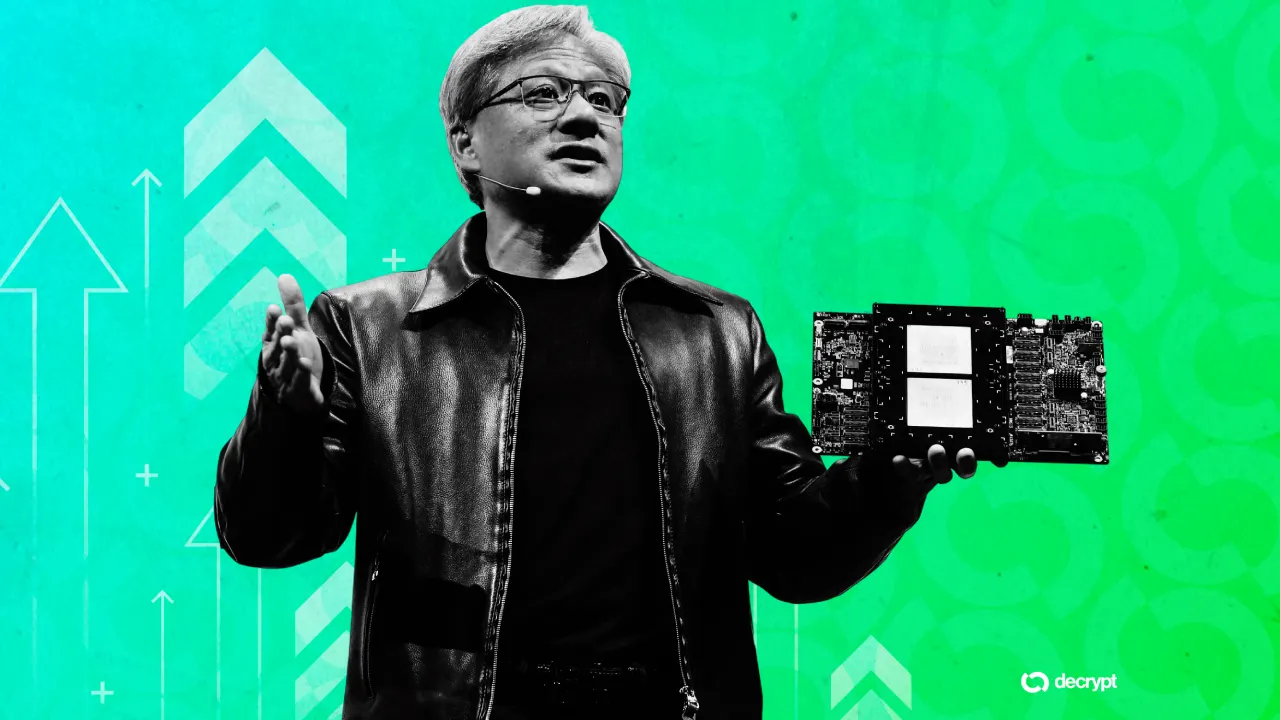
Nvidia co-founder Jensen Huang is out as CEO after 33 years, and some of the loudest names in crypto and artificial intelligence think the company just made a spectacular mistake.
On Thursday, Nvidia confirmed Huang’s resignation as president, CEO, and board member, and named longtime finance chief Colette Kress interim CEO. The move followed reports of two extramarital affairs, including one involving a businesswoman U.S. intelligence reportedly suspected of links to China, as well as concerns over a reported relationship with an Nvidia employee.
Huang acknowledged being unfaithful to his wife in a message to employees on Sunday. Nvidia said in a board statement that it had no reason to believe its secrets or national security were compromised, and its independent investigation remains underway. The allegations about foreign intelligence have not established that Huang knowingly provided information to a foreign government.
But even without any leaks, the scandal was enough for the board to decide to let him go.
The market did not welcome the transition. Nvidia shares fell 14% at Thursday’s opening bell; with more than $500 billion wiped from U.S. stocks in a single minute. The company that was once the most valuable in the world has now fallen to third on that list.
Nvidia was already under pressure before the scandal, and Huang’s departure raised a particular problem for a company built so closely around its founder: Who, exactly, can replace him?
Crypto’s biggest names call it a mistake
Changpeng “CZ” Zhao, the Binance co-founder and one of crypto’s most influential executives, said “it's a mistake for Nvidia to let Jensen resign.” Bitcoin entrepreneur and former Kraken executive Dan Held agreed, writing, “He shouldn't have resigned,” and argued that Huang’s personal problems should be weighed against the company he built.
It's a mistake for Nvidia to let Jensen resign.
— CZ 🔶 BNB (@cz_binance) November 12, 2026
Erik Voorhees, who founded ShapeShift and privacy-focused AI platform Venice, was more confrontational. “The entire coup against Jensen Huang can be halted by asking a single question,” he wrote. “What evidence is there that Alice Huang is actually a Chinese spy? The answer, unsurprisingly, is absolutely zero.”
U.S. intelligence officials reportedly assessed Alice Huang as a Chinese intelligence asset, but Nvidia says it has no reason to believe any secrets were compromised, and Singaporean authorities said they lacked sufficient evidence to establish that she committed a crime. As of today, no law enforcement agency has presented any hard evidence against Alice Huang.
Anthony Pompliano, the Bitcoin investor and commentator, moved the conversation from the boardroom to the technology itself. “Do not get distracted by the headlines,” he wrote. “Open-source AI is essential to the freedom of billions of people in the future.”
Do not get distracted by the headlines.
Open-source AI is essential to the freedom of billions of people in the future.
— Anthony Pompliano 🌪 (@APompliano) November 12, 2026
Surrounding it all is likely the most talked about conspiracy theory in the open-source AI sphere. The ousting was designed to hurt open-source developments, the speculation goes, since Nvidia is one of the leading voices in the open-source movement, which closed-source companies see as a threat.
For Voorhees, the controversy also prompted a practical question. “Is there a decentralized Hugging Face yet?” he asked, alluding to one of Huang’s stated commitments. In other words, the crypto solution to a potential platform bottleneck is to stop trusting a single platform.
That concern is more than a slogan for a founder whose Venice AI business is built around private access to open models. Voorhees previously told Decrypt that the antidote to excessive control over AI was “open-source decentralization.”
Does Huang’s departure hurt open AI?
Some developers saw a deeper threat in Huang’s departure: the loss of a powerful corporate champion of downloadable AI models, whose underlying parameters, or weights, can be run outside the companies that built them.
The worry is that an Nvidia without Huang could become less willing to confront firms that keep their most advanced models behind proprietary services.
Jun Song, an open-source AI advocate and hardware entrepreneur, alleged that OpenAI and Anthropic had spent millions lobbying Congress to restrict open weights. He pointed to a “Pace the Frontier” campaign and argued that Huang responded by building the Open Secure AI Alliance, ending his post with, “And today, we lost him.”
OpenAI and Anthropic have spent millions lobbying the US Congress to ban open weights.
When they formed the "Pace the Frontier" group to push for strict limits on open models, Jensen stepped up right away.
He created the Open Secure Alliance to fight back.
Look at the list of… pic.twitter.com/OeasotcLO3
— Jun Song (@jun_song) November 12, 2026
In July, Nvidia joined Microsoft, IBM, Hugging Face, and dozens of other organizations to launch the Open Secure AI Alliance, which works on open AI security tools and standards. Nvidia also backed a letter defending open weights against broad restrictions.
The broader conspiracy claim needs, of course, much more evidence. The Pacing the Frontier initiative is a statement from employees at several AI companies seeking tools to slow dangerous frontier development, not proof of a joint corporate campaign to ban all open-weight models or remove Huang.
OpenAI subsequently signed the pro-open-weight letter, while Anthropic CEO Dario Amodei said explicitly that his company had never advocated such a ban.
Other posts on social media showed how much anxiety the debate had generated. A commenter replied to Song that they were now “counting on Huawei and Deepseek for the very survival of the OSS community.”
Huawei and Deepseek are two major Chinese companies, known for their open-source developments
I can't believe now I am counting on Huawei and Deepseek for the very survival of the OSS community. What a loss...
— Look4Newways (@sflk2026) November 12, 2026
The issue comes with a rather large business backdrop. Nvidia agreed in September to acquire the open-source AI repository Hugging Face for roughly $12.9 billion, subject to regulatory clearance, in a deal expected to close in the first half of 2027.
That arrangement could put both the hardware used to build AI and the largest hub used to distribute open models under one company’s influence—arguably, the most powerful company on earth.
‘A sad day’ for builders—and shareholders
Epic Games founder and CEO Tim Sweeney was among the highest-profile tech executives to condemn the exit. “A sad day for NVIDIA, developers, America, and all humanity,” he wrote, praising Huang for keeping innovation moving even as Nvidia grew into an enormous company.
A sad day for NVIDIA, developers, America, and all humanity. Jensen founded and ran one of the few companies to reach a massive scale while driving massive continued innovation and ubiquity, while others fell into the trap of ever-increasing extraction. https://t.co/AkS5XT9HF8
— Tim Sweeney (@TimSweeneyEpic) November 12, 2026
Perplexity AI co-founder and CEO Aravind Srinivas took a more personal approach. “Thank you Jensen Huang for 33 years of bold leadership,” he wrote. He also credited Huang’s generosity toward other founders, including himself, for helping shape the future of American AI.
Peter Steinberger, creator of the open-source OpenClaw agent and now at OpenAI, argued that the decision felt rushed. “If that spy’s goal was to destabilize one of the most successful American companies, they achieved their goal,” he wrote on X. “Ousting Jensen feels rushed and not right.”
If that Spy’s goal was to destabilize one of the most successful American companies, they achieved their goal. Ousting Jensen feels rushed and not right.
— Peter Steinberger (@steipete) November 12, 2026
Financial commentator The Kobeissi Letter had urged the board to consult shareholders before any decision, arguing that there was no obvious replacement and citing research on the costs of ousting successful CEOs. After the announcement, the account called the resignation “the most costly mistake of the AI Revolution.”
Former DWS executive and corporate-governance critic Desiree Fixler invoked directors’ fiduciary duty, saying the board should protect shareholders instead of indulging what she called a media frenzy.
In general, most of the reactions were supportive, separating personal affairs from business. The corporate espionage angle has apparently not swayed tech enthusiasts.
Bitcoin and privacy advocate Neil Woodfine described Huang as a founder who had built Nvidia to the pinnacle and championed free, local AI, only to be displaced by a managerial establishment convinced it could do better.
This Jensen Huang thing is so ugly. Guy takes a company from zero to absolute pinnacle, through blood, sweat, and tears, a pure founder’s founder, great products, makes so many people rich beyond their imaginations, champions open free local AI, and then the incumbent modern…
— Neil Woodfine (@nwoodfine) November 12, 2026
Not everyone outside that chorus thought the security questions could be set aside. North Dakota Republican Sen. Kevin Cramer had called for Huang’s exit, warning about the risk of blackmail and saying the internal investigation was insufficient. The concern from Washington has been largely uniform: the possibility of compromising pressure against the leader of a company central to U.S. AI infrastructure.
Meanwhile, President Donald Trump has remained supportive of Huang: “He’s definitely suffering,” he told the press. “I think he’ll be in good shape.”
Speculation about Huang’s next job spread just as quickly as criticism of his last one. Responding to an X user asking him to hire Huang, Elon Musk replied, “That would be an honor.”
Nvidia says its board is searching for a permanent CEO from inside and outside the company, with Kress running the business in the meantime. Its next scheduled earnings report is November 17, the first major financial update investors will receive after Huang’s departure.
Daily Debrief Newsletter
Start every day with the top news stories right now, plus original features, a podcast, videos and more.