





The defining strategy of 2025 was not choosing a single “best large language model.” It was assembling a stack. Claude for premium coding and editing. DeepSeek or Qwen for cheap volume. Muse for fiction. Dolphin when constraints mattered more than polish.
Models stopped being personalities this year. They became tools. The advantage went to users who treated them that way.
The technology matured into something genuinely useful in 2025—models became smarter, cheaper, and specialized for specific tasks. The era of chasing a single "best" model was over.
Here's which models earned their spot in our stack.
Coding
Vibe coding, the ability to make AI code with simple instructions, was super hyped in 2025. These are the best models for both vibe coders and real programmers using tools for AI-assisted coding.
The Best
For teams that needed a coding model they could rely on without babysitting, Claude Opus 4.5 stood out. Anthropic reports an 80.9% score on SWE-bench Verified, and in practice the model matched that reputation: strong reasoning, low hallucination rates, and a conservative style that makes it suitable for production environments.
The tradeoff is cost and context efficiency. Opus is expensive, and long sessions can burn through its context window quickly. For professional developers shipping real software, that was often acceptable. For casual or exploratory coding, it frequently wasn’t.
Best Value
Chinese startup DeepSeek V3.2 costs $0.28 per million input tokens which makes it extremely cheaper compared to its western counterparts. The model also ships with MIT-licensed weights for V3.2 projects, giving teams full ownership and modification rights.
Deepseek released a “Speciale” version that is even better at this. It’s only available via API, though.
Agentic Tasks
AI that can do everything for you without you guiding them and supervising every single step—that is the promise of agentic AI.
These models execute multi-step workflows, browse websites, and recover from execution errors. The agentic category emerged as 2025's defining battleground.
The Best
OpenAI's GPT-5.2 “Thinking” model leads here with 80% on SWE-bench Verified, alongside explicit positioning around end-to-end execution and tool-calling performance. The model intelligently routes between fast responses and deep reasoning depending on task complexity, making it ideal for workflows that need to actually finish rather than just start.
Best value
MiniMax M2's efficiency profile makes it particularly attractive for businesses running interactive agents at scale. The sparse MoE architecture means lower latency and higher throughput for batch sampling—exactly what customer support automation and R&D workflows need.
With pricing at approximately $0.01 per 1K tokens (significantly lower than frontier models), companies can afford to deploy it across entire departments for tasks like knowledge base queries, automated research summaries, and document processing without worrying about runaway costs.
NVIDIA's Nemotron 3 family of models, released December 15, brings hybrid Mamba-Transformer architecture to consumer GPUs. It’s a super new family of models that’s worth keeping an eye on.
Chat Bots
These are the models that are great jack of all trades: versatile, knowledgeable and cheap enough to talk to you for a long time
The Best
GPT-5.2 remains the most well-rounded option. It maintains 60.5% market share and approximately 800 million weekly active users, with one killer feature competitors still lack: Memory. The model remembers previous conversations and builds relationships with users over time, eliminating repetitive context-setting.
OpenAI also made sure to make this model more approachable to appraise to the GPT-4o cult which demanded the company to bring that old model back. In theory, this should have the power of GPT-5 with the “humanity” of GPT-4o
Best value
Alibaba's Qwen 2.5 became the foundation for 40% of new fine-tuned models globally. It supports multiple languages and maintains an Apache 2.0 license permitting unrestricted commercial use. Organizations can fine-tune it on internal documents and deploy locally without sending data to third-party APIs. It is also open source—which means users can train, tweak and use if for free if they have the hardware—and comes in different sizes and flavors
Creative Writing
2025 was the year in which AIs were measured by the complexity of the logical tasks they solved. But when it comes to creativity, imagination, and art, things are a lot more complicated. The jump in quality may not be as big as in the other areas, but that doesn’t mean there are not models for this type of users.
The Best
Based purely on numbers, OpenAI's GPT-5 Pro scores 8.474 on the Lechmazur Writing Benchmark V4—the highest recorded for any LLM. It also requires some deep pockets with the subscription being $200 per month.
You may want to try it if you really want to, but for most guys, those $200 would be better spent somewhere else. In our opinion, LLMs are not really amazing at creative writing—and AI companies seem to not care about this too much.
Best Value
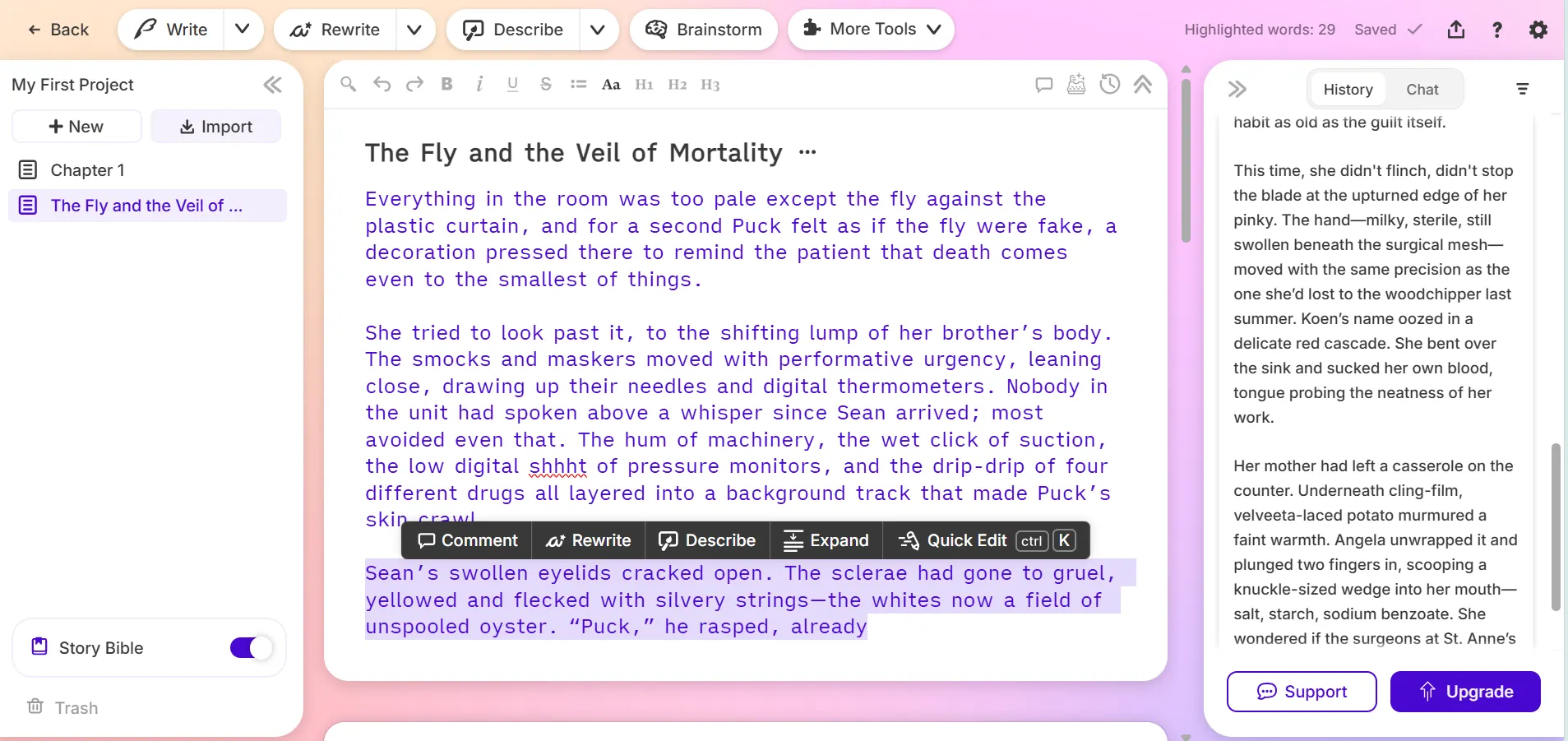
Sudowrite's Muse model is another great model for creative writers as it was built specifically for fiction. Muse offers narrative engineering pipelines that help chapters stay on track without meandering—though it's exclusive to the Sudowrite platform and less filtered about adult themes than mainstream alternative.
Best Open Source Alternative
That said, for long stories, we would still recommend the ancient “Longwriter,” from 2024. It is not the best by any means, but it is capable of producing pages and pages of creative content at once. Use it to draft a quick base and then feed that to your model of choice to refine the chapters or work on the details, twist the story, etc.
Uncensored and NSFW
Do you need an AI to help you with your next Hellraiser script? Do you want to get kinky with your AI? Then you need an uncensored model… and boy, forget about big tech for this. This category isn't about intelligence. If you really need uncensored AI writing, you should care about the models’ inherent constraints, And the best option is going local
To be fair, any abliterated version of an open source model should do the trick. When a model is abliterated, it basically loses its ability to refuse outputs.
The Best
The Dolphin models are a classic pick. The 70-billion-parameter variant removes all safety restrictions through "alignment detox" training.
Worth noting: if you're building locally on Meta's Llama line, it's not Apache—it's under the Llama 3.3 Community License with its own terms and restrictions.
Qwq-abliterated is another truly effective uncensored fine-tune. The model is a finetune version specifically designed as uncensored as a model can be.
Science, Research and Business
The Best
Gemini 3 Pro's 91.9% on GPQA Diamond and perfect 100% on AIME 2025 represent historic achievements in AI reasoning. The Deep Think mode enables it to work through complex scientific problems methodically. Its 10-million-token context allows researchers to upload entire papers and their references for comprehensive analysis.
Best Value
If you prioritize stability over bleeding-edge performance, Z.AI’s GLM-4.6 has carved out a strong position. The open licensing under MIT gives businesses freedom to customize, self-host, and fine-tune without vendor lock-in or compliance restrictions. At roughly one-third the API cost of comparable Western models, it's a good practical choice for high-volume internal tooling.
Most versatile
Alibaba’s Qwen3 open weights enable researchers to study model behavior, fine-tune for specialized domains, and deploy without API dependencies. Its multilingual capabilities make it particularly valuable for international research collaborations.
What makes this model special for business and science is that it offers the best research agent in the market, for free, if you use it on the official Qwen Chat platform.